
Choosing Between a Government and Private Hospital for Delivery in India: What to Consider
An honest guide to the real differences between government and private hospital delivery in India — cost, quality, facilities, C-section rates, and the factors that matter most to your specific situation.
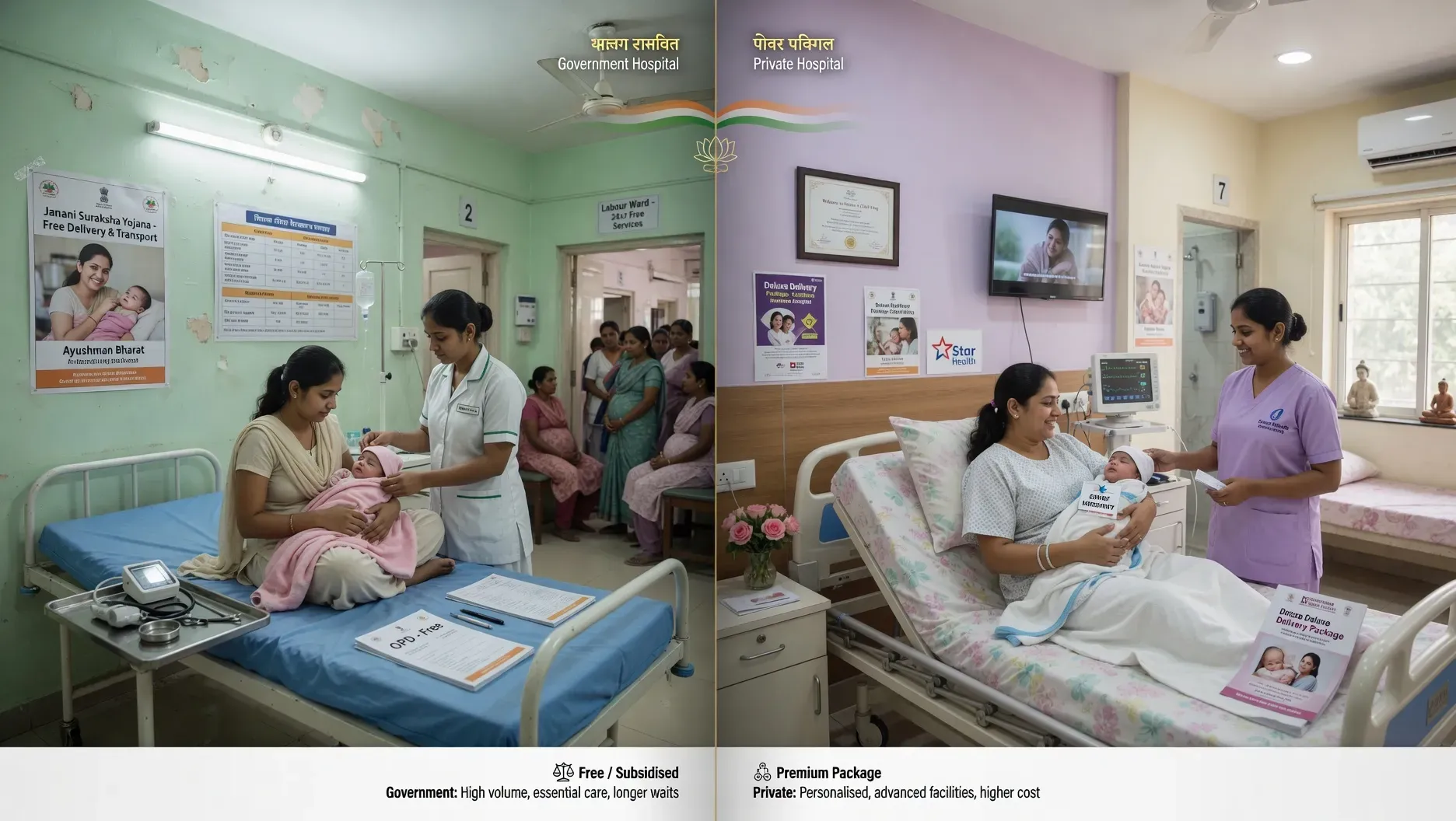
The choice between a government and private hospital for delivery is one of the most significant practical decisions of pregnancy in India — with implications for cost, quality of care, access to specific services, and the experience of labour and birth. It is also a decision that is made with incomplete information by most families, often based on assumptions that may not reflect the reality of the specific institutions available to them.
This guide does not make a universal recommendation — the right choice depends entirely on your specific circumstances, your location, the specific facilities available to you, and your individual health situation. What it does is give you the factors that actually matter for making this decision well.
The honest picture of government hospitals
India’s government hospital system — including Medical College hospitals, district hospitals, and ESIC/government health scheme facilities — ranges from genuinely excellent to deeply inadequate, often within the same city.
What government hospitals do well:
At the apex level — All India Institute of Medical Sciences (AIIMS) and equivalent Medical College hospitals in major cities — the standard of obstetric care is often very high. These are training hospitals with obstetricians, neonatologists, anaesthesiologists, and full surgical facilities available. They handle high-risk pregnancies and complications that smaller private facilities are not equipped for.
Government hospitals are the only realistic delivery option for the majority of the Indian population. The Janani Suraksha Yojana (JSY) and similar schemes have significantly improved institutional delivery rates by providing financial incentives for facility-based birth.
The challenges:
Overcrowding is the defining reality of most government hospital maternity wards. Multiple women labouring in shared spaces is common. The doctor-patient ratio is low. Personalised attention is limited. Waiting times can be long. The physical environment and facilities are often inferior to private facilities.
NICU (neonatal intensive care unit) availability at government hospitals is uneven — the best government hospitals have excellent NICUs; smaller facilities may not.
Who should seriously consider a government hospital:
Women with high-risk pregnancies (complex medical conditions, suspected complications) are sometimes better served at a Medical College hospital with the full range of specialist backup than at a smaller private hospital. Women whose financial situation makes private hospital costs genuinely prohibitive. Women enrolled in government health schemes that provide free delivery care at specific facilities.
The honest picture of private hospitals
Private hospitals in India span an enormous range — from corporate hospital chains to small standalone maternity clinics. The quality, facilities, and practices within “private hospitals” vary as much as between government and private.
What private hospitals typically offer:
Individual or semi-private rooms rather than shared wards. Lower doctor-to-patient ratios and more individualised attention. Generally more comfortable physical environments. Shorter waiting times. More likely to have epidural anaesthesia available (though not universal). More amenity-focused care.
The challenges:
Cost is significant and highly variable. A private hospital delivery in a metro city can range from AED equivalent — roughly INR 50,000 to INR 5,00,000 or more depending on the hospital tier, type of delivery, and any complications.
C-section rates at many Indian private hospitals are significantly higher than at government hospitals and significantly higher than clinical indications warrant. The reasons are complex — medicolegal concerns, financial incentives in fee-for-service models, scheduling convenience — but the reality is that a woman at many Indian private hospitals faces a statistically higher chance of having a C-section than she would at a government facility, regardless of whether a C-section is clinically necessary.
Not all private hospitals have the NICU or specialist backup for genuine emergencies. A small private maternity clinic may not have an anesthesiologist available at 3am, which affects epidural access and emergency surgical capability.
Questions to ask any facility before committing
These questions apply to both government and private options:
- What is your caesarean section rate?
- Is epidural analgesia available 24 hours a day?
- Is there an anesthesiologist on call overnight and on weekends?
- What is your NICU level and what conditions can it manage?
- What is the patient-to-nurse ratio in the labour ward?
- What happens if a complication arises that is beyond your facility’s capacity?
A facility that is not willing to answer these questions directly warrants scepticism. These are standard quality questions that any hospital should be able to answer.
The C-section rate question
This deserves specific emphasis. India’s private hospital C-section rates in urban areas are among the highest in the world for healthcare facilities, and the rate of medically indicated C-sections does not explain the disparity with government hospitals.
If you are planning a vaginal birth, asking your specific obstetrician and your specific facility about their C-section rates — and getting a direct answer — is one of the most important questions of your antenatal care. An obstetrician whose C-section rate is 70% is practising differently from one whose rate is 25%, and the difference matters for your birth.
Insurance and financial considerations
If you have health insurance, check specifically what is covered for maternity: whether normal delivery and C-section are covered, what the waiting period is, what documentation your insurer requires, and whether your preferred hospital is on the insurer’s approved network. Many maternity insurance products have 2–4 year waiting periods, which means coverage requires pre-planning before pregnancy.
Government health schemes — CGHS, ESIC, Ayushman Bharat, and state-level schemes — provide covered delivery care at specified facilities. If you are eligible for such a scheme, understanding what your entitlement includes is worthwhile.
Making the decision
The factors that typically drive a good decision are:
- Your specific health situation and risk factors
- The specific facilities actually available to you (not hospitals in general but the government and private options geographically accessible to you)
- The quality of the specific obstetrician you have built a relationship with, independent of the hospital they are attached to
- Financial reality
- The specific services you know you may need (epidural, NICU availability, specific specialist)
The decision is not “government versus private” as a category — it is which specific institution provides the best combination of quality, access, and appropriate care for your specific pregnancy.
This article is for general informational purposes only. The quality and capabilities of specific hospitals vary enormously. Visit the facilities you are considering, ask the questions listed above, and make an informed decision based on your individual circumstances.