Pregnancy and Sitting All Day: How to Protect Your Posture at a Desk Job
A practical guide for pregnant women who work desk jobs — how to set up your workspace, what posture changes matter, how often to move, and how to manage the specific discomforts of sitting all day during pregnancy.
Most pregnancy exercise and movement guidance is written for women who have some control over their physical activity during the day. It says considerably less about the reality of sitting at a desk for seven to eight hours, in a chair that was not designed for a pregnant body, in an office environment where taking a break every 30 minutes to walk and stretch is not always practically possible.
If you work a desk job during your pregnancy — which describes the majority of working pregnant women in Indian cities — this guide is specifically for you.
What prolonged sitting does to a pregnant body
Sitting still for extended periods during pregnancy creates several interconnected problems:
It increases lumbar load. Seated posture, particularly slumped seated posture, increases the pressure on the lumbar discs and the load on the posterior muscles of the lower back. In pregnancy, when the forward-shifted centre of gravity already predisposes the lower back to strain, adding several hours of sitting makes back pain significantly worse.
It reduces circulation in the legs. Pregnancy already increases the risk of blood pooling in the legs due to the uterus pressing on the inferior vena cava and the increased blood volume. Prolonged sitting — with the back of the thighs pressing against the chair and reduced muscle pump activity in the legs — worsens venous stasis, increases leg swelling, and in higher-risk cases increases thrombosis risk.
It shortens the hip flexors. The hip flexors — the muscles connecting the front of the hip to the lumbar spine — become shortened with prolonged sitting, pulling the pelvis into an anterior tilt and increasing lumbar lordosis. This is a significant contributor to back and pelvic pain.
It increases pelvic floor load. Sitting for extended periods, particularly in a slumped position, places the pelvic floor in a mechanically disadvantaged position and can contribute to pelvic floor dysfunction.
Workstation setup for pregnancy
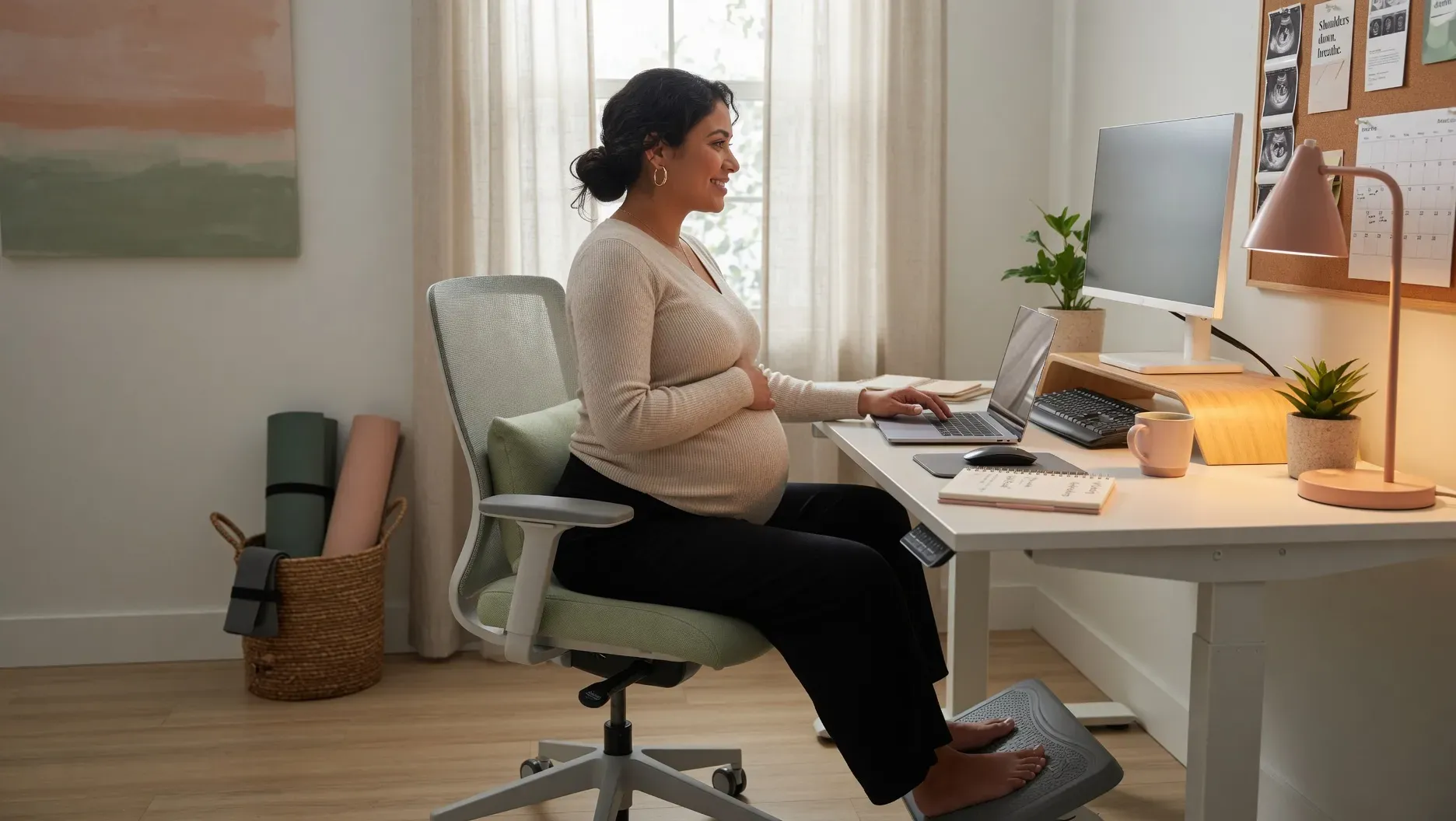
Chair height and support. Your feet should be flat on the floor (or on a footrest) with hips at approximately 90 degrees. The lumbar region of the chair should support the natural curve of the lower back — if your chair’s lumbar support is inadequate, a small lumbar roll or rolled towel behind the lower back makes a significant difference. The height of the chair should allow your forearms to rest on the desk with shoulders relaxed.
As the pregnancy progresses, the bump changes your ideal sitting position. You may need to move the chair back from the desk, raise the chair, or adjust the monitor height as your body changes. Reassess your setup each trimester.
Monitor height. The top of your monitor should be approximately at eye level to avoid the neck flexion that contributes to upper back and neck pain, which is compounded by pregnancy postural changes.
Keyboard and mouse placement. Close enough to the body that you are not reaching forward, which rounds the shoulders and increases thoracic and neck strain.
Consider a standing desk or height-adjustable desk. If available, alternating between sitting and standing throughout the day significantly reduces the cumulative load of sustained sitting. Even if you cannot stand for long periods in late pregnancy, even 30 minutes of standing spread through the day reduces the sitting load.
Posture during sitting
The most important postural principle during pregnancy desk work is to sit with the natural curves of the spine supported rather than slumped. This means:
- Sitting toward the front or middle of the chair rather than slumped back
- The pelvis in a neutral position — not tucked under (posterior tilt) and not excessively tilted forward (anterior tilt)
- The lower back gently curved inward, supported by the chair or a lumbar roll
- Shoulders back and down, not hunched forward
- The head balanced over the spine, not jutted forward
This is not about maintaining a rigid, military posture — it is about avoiding the habitual slump that causes the most strain. Micro-movements throughout the day — small shifts in weight, adjustments of position — are protective.
Movement breaks
The most evidence-supported intervention for desk-job pregnancy discomfort is simply moving more frequently.
Set a timer for every 30–45 minutes. When it goes off, stand, walk briefly, and do a few stretches before sitting again. Even 2–3 minutes of movement breaks the static load accumulation that leads to pain.
Walk at lunch. A 10-15 minute walk during the lunch break maintains circulation and provides the movement that the rest of the day may lack.
Stretch at your desk. Several stretches can be done at the desk without requiring floor space:
- Neck rolls and shoulder rolls (release upper back tension)
- Seated hip flexor stretch (shift to the edge of the chair and gently slide one foot back, feeling the stretch in the front of the hip)
- Ankle circles (promote circulation in the lower legs and feet)
- Seated figure-four stretch (cross one ankle over the opposite knee, gently press the crossed knee down — releases the piriformis and glutes)
Specific third trimester desk considerations
In the third trimester, the bump makes comfortable desk sitting progressively more challenging. Specific adjustments:
Leg elevation. A footrest that allows you to raise your feet slightly reduces leg swelling and reduces the load of the bump’s weight on the pelvic floor.
Cushioning. A coccyx or donut cushion reduces the pressure on the tailbone and perineum, which become increasingly uncomfortable with prolonged sitting in late pregnancy.
Frequent bathroom breaks. The pressure of the baby’s head on the bladder in the third trimester makes the need to urinate more frequent and more urgent. Take these breaks — do not resist them.
Communicate with your employer. If your work requires extended desk sitting without adequate break opportunity, discussing this with your employer is appropriate. In India, the Maternity Benefit Act provides for certain protections for pregnant employees, and requesting reasonable accommodations — a more supportive chair, a footrest, more flexible break scheduling — is a legitimate conversation.
This article is for general educational purposes only. If you are experiencing significant discomfort related to desk work during pregnancy, speak with your doctor or a physiotherapist for individualised guidance.