
What the Vernix Is and Why It Matters for Your Newborn's Skin
A clear, warm guide to vernix caseosa — what this waxy white coating is, why it forms, what it does for your newborn, and why immediate bathing removes something worth keeping.
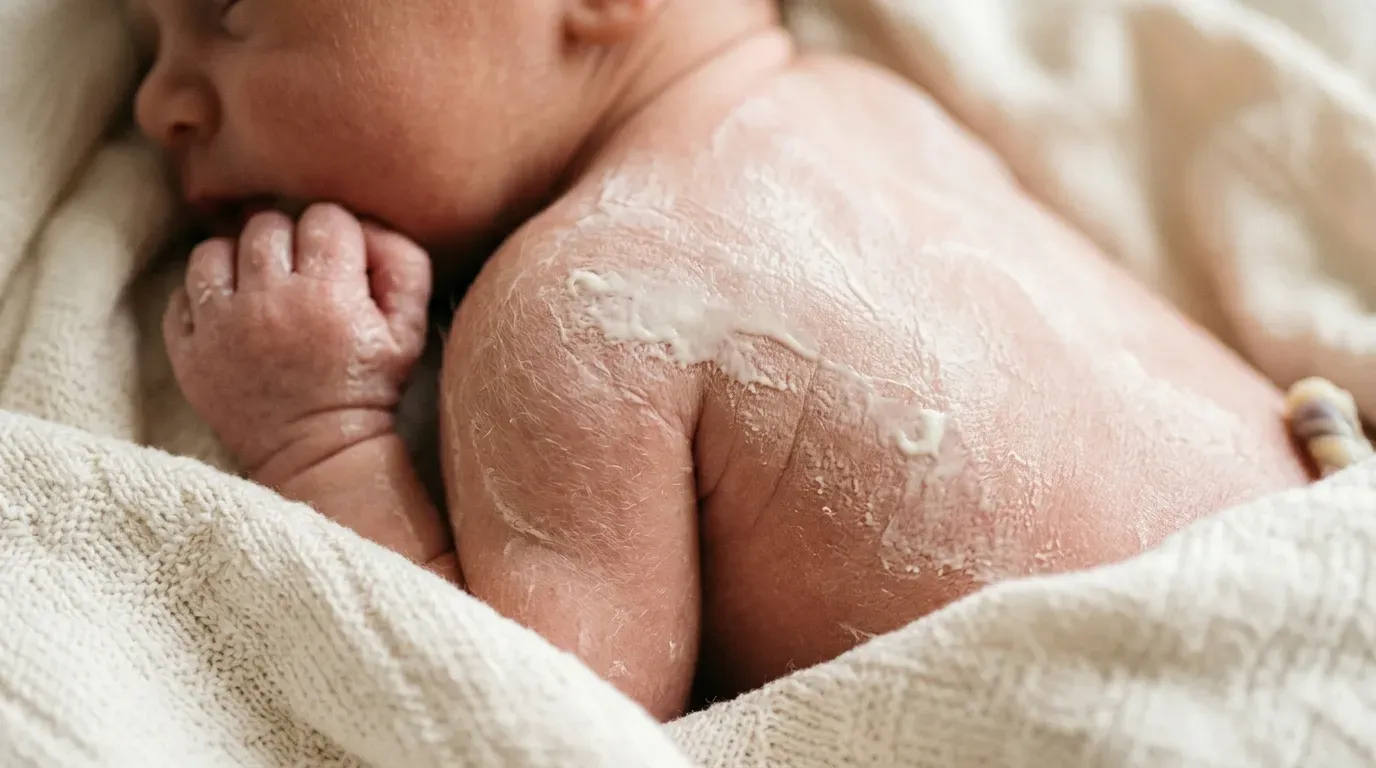
If you have seen a baby immediately after birth — in a photograph, on a video, or in person — you have likely noticed the white, waxy, cream-cheese-like coating on the baby’s skin. This is vernix caseosa, and it is one of the more remarkable substances the body produces during pregnancy: a specialised coating that forms on the fetal skin during the third trimester, protects the baby in the womb, and continues to serve an important function in the hours and days after birth.
Understanding what it is and why it is there changes the way you might approach your newborn’s first bath — and might lead you to ask for something that many hospitals in India do not routinely offer but which the evidence supports strongly: delaying that bath.
What vernix actually is
Vernix caseosa — from the Latin for “varnish cheese” — is a biofilm that forms on the skin of the developing fetus during the third trimester of pregnancy. It is produced by the sebaceous glands of the fetal skin, and its composition is remarkably complex: approximately eighty percent water, ten percent lipids (fats), and ten percent proteins, with a specific combination of antimicrobial peptides, antioxidants, and moisturising compounds that do not have a simple pharmaceutical equivalent.
Vernix begins forming at around twenty-eight weeks of pregnancy, peaks in abundance around thirty-two to thirty-six weeks, and then begins to reduce as the due date approaches. A baby born prematurely often has more vernix than a full-term baby; a baby born post-term (after forty-two weeks) may have very little, as it has been largely reabsorbed into the amniotic fluid.
The vernix does not sit inertly on the skin — it is integrated into it, coating the stratum corneum (the outermost layer of the skin) in a way that is more like a biological barrier than an external coating.
What vernix does in the womb
Protection from amniotic fluid. The fetus spends approximately forty weeks immersed in amniotic fluid. Without protection, this sustained exposure to fluid would macerate (soften and break down) the skin. Vernix provides a waterproof barrier that prevents fluid from penetrating the skin layers, keeping the skin’s structural integrity intact.
Temperature regulation. The uterine environment is warm, but the fetus generates its own metabolic heat. Vernix helps retain that heat and contributes to the maintenance of fetal skin temperature.
Lubrication for birth. One of vernix’s proposed functions is mechanical: coating the baby in a slippery, protective layer that may ease passage through the birth canal. Whether this is a primary function or an incidental property is debated, but the lubricating quality of vernix is real.
Antimicrobial protection. The birth canal is not a sterile environment. During passage through it, the baby is exposed to maternal vaginal and rectal bacteria — some beneficial, some potentially harmful. Vernix contains several antimicrobial peptides including lysozyme, lactoferrin, defensins, and secretory immunoglobulin A (sIgA) — the same compounds found in breast milk. These provide a first-line defence against bacterial colonisation of the newborn skin during and immediately after birth.
What vernix does after birth
This is where vernix’s role is most practically relevant to newborn care decisions:
Continued antimicrobial protection. In the first hours and days after birth, the newborn’s immune system is immature. The skin is the primary barrier against infection. Vernix’s antimicrobial compounds continue to protect the skin surface against bacterial colonisation during this vulnerable period.
Skin barrier function. The newborn skin, despite being fully formed, is still maturing its barrier function in the days after birth. Vernix supports this transition — covering the skin while its own barrier mechanisms consolidate. Research has shown that newborn skin with vernix intact has significantly better barrier function (measured by transepidermal water loss) than skin from which vernix has been removed.
Moisturisation and wound healing. The lipid composition of vernix moisturises the skin surface and supports the early healing of any skin disruption that may occur during birth. Its protein components include growth factors that support skin cell function.
pH regulation. Newborn skin is initially alkaline and shifts to a more acidic pH in the first days of life — an important part of establishing the skin’s microbiome. Vernix is slightly acidic (pH around 4-5) and supports this transition. Washing a newborn immediately removes this pH-regulating substance and temporarily increases skin pH, which creates a less hostile environment for potentially harmful bacteria.
Thermoregulation. Vernix has insulating properties that help newborns maintain body temperature in the first minutes after birth — a period when rapid heat loss from a wet surface in a relatively cool delivery room is a real challenge.
Why immediate bathing removes something worth keeping
The routine of bathing a newborn immediately or very soon after birth is embedded in many hospital practices in India — and it is a practice that the evidence now challenges.
The World Health Organization recommends delaying the first bath for at least twenty-four hours after birth, or a minimum of six hours if cultural considerations make twenty-four hours unacceptable. The American Academy of Pediatrics made similar recommendations in 2020, citing the evidence on vernix’s protective functions.
The reasons immediate bathing is recommended against:
It removes antimicrobial protection at the most vulnerable time. The first hours of life are the period of highest skin infection risk. Removing vernix immediately exposes the newborn skin to the hospital environment without its primary defensive coating.
It contributes to hypothermia risk. Newborns are at significant risk of hypothermia immediately after birth. Bathing accelerates heat loss. Delayed bathing reduces this risk.
It may interfere with breastfeeding initiation. Research has found that immediate bathing, by separating mother and baby, may delay the first breastfeeding and affect milk supply establishment. Skin-to-skin contact in the first hours is among the most evidence-supported interventions for breastfeeding success; bathing interrupts it.
It removes a substance the body has spent weeks producing. The vernix is not a byproduct or waste material to be cleaned away — it is a deliberately synthesised substance with specific functions. Removing it immediately after birth discards those functions at the moment they are most needed.
What to ask for at your hospital
In many Indian hospitals, immediate bathing of newborns is standard practice — sometimes because of hygiene assumptions, sometimes because of cultural beliefs about cleanliness, sometimes simply because of custom. It may require a specific request to delay it.
If you wish to preserve your baby’s vernix, you can request:
Delayed first bath — at least six hours after birth, preferably twenty-four hours. Explain that you understand the evidence on vernix and would like to preserve it for the first day.
Vernix massage — rather than washing it off, the vernix can be gently massaged into the skin rather than removed. It absorbs naturally and provides the same benefits. This is a practice used in some neonatal units for premature babies and can be applied to full-term newborns as well.
Skin-to-skin contact before any bath — at minimum, ensuring that skin-to-skin contact occurs before any bathing, protecting the vernix during the critical first breastfeeding period.
No rubbing of vernix during initial assessment — routine towel drying of the newborn after birth can remove vernix from the skin. Requesting gentle rather than vigorous drying preserves more of it.
What about babies born by caesarean section
Babies born by caesarean section have not passed through the birth canal and are therefore not exposed to the same microbial environment that vaginal birth involves. However, the vernix itself forms during fetal skin development and is present regardless of mode of delivery. The skin protection, moisturisation, and antimicrobial properties of vernix apply equally to caesarean-born babies, and delayed bathing is appropriate for them as well.
There is also a specific consideration for caesarean-born babies: they miss the vaginal microbial exposure that vaginal birth provides, which shapes the infant microbiome. This has generated research into vaginal seeding (exposing caesarean-born babies to maternal vaginal secretions at birth), though this is not standard practice. Preserving vernix does not replace vaginal birth’s microbial contribution, but it does maintain one element of the protective biological environment that birth was designed to provide.
Vernix as a marker of gestational maturity
Because vernix peaks at around thirty-two to thirty-six weeks and reduces thereafter, the amount present at birth provides a rough indicator of gestational maturity. Premature babies are often heavily coated in vernix; post-term babies may have very little. This is one of the observations used in the Ballard score — a clinical assessment of newborn maturity used when gestational age is uncertain.
For parents of premature babies in a neonatal unit, the presence of vernix on their baby is worth knowing about: neonatal units caring for very premature babies sometimes specifically avoid wiping off vernix and may use it gently as a skin treatment because of its benefits for the extremely fragile, immature skin of very preterm infants.
The cultural context in India
In many Indian communities, immediate bathing of the newborn is a cultural expectation — sometimes for religious reasons (the first bath as purification), sometimes for reasons of cleanliness, sometimes simply as tradition. Understanding the evidence around vernix does not require abandoning cultural practice, but it is worth having an honest conversation with your provider and, where possible, with family about what the first bath timing actually means for your baby’s health.
For families for whom cultural or religious bathing of the newborn is important, even a delay of six hours preserves much of the vernix’s protective function in the most critical period immediately after birth. The delay does not need to be twenty-four hours to provide significant benefit over immediate bathing.
The honest message
The vernix coating on your newborn is not something to be cleaned away as quickly as possible. It is a finely engineered biological substance that has been built over weeks of fetal development and that continues to serve specific, well-documented functions in the hours and days after birth.
Knowing this means you can make an informed decision about the first bath — when it happens, and how. It means you can have a conversation with your hospital about delayed bathing before the birth rather than in the immediate, overwhelming moments after it. And it means that the white coating on your baby’s skin, whatever you ultimately decide about the timing of bathing, is something you understand as what it actually is: a gift from the pregnancy, still working, still protecting.
This article is for general educational purposes only and does not replace personalised medical advice. Always consult your doctor, midwife, or a qualified healthcare professional about newborn care decisions in your specific situation.