Eating for Two Is a Myth: How Much to Actually Eat in Each Trimester
How many extra calories pregnancy actually requires, what that looks like trimester by trimester, and why quality matters more than quantity.
“Eating for two” is one of the most enduring pieces of pregnancy advice, and one of the most misleading.
The idea that pregnancy requires doubling your food intake — or even significantly expanding it — does not reflect what the body actually needs. The second person you are eating for begins as a cluster of cells and grows to roughly three kilograms at birth. The extra energy required to support that growth is real, but it is considerably more modest than popular wisdom suggests, particularly in the first trimester when the phrase most enthusiastically circulates.
What matters more than quantity — throughout pregnancy and especially in the early months — is quality. A small, consistent increase in nourishing food serves the pregnancy better than a large increase in any food available. Understanding what the numbers actually look like, trimester by trimester, makes this easier to act on without guilt in either direction.
First trimester: the energy requirements haven’t changed yet
Here is the number that surprises most people: in the first trimester, the additional calorie requirement is essentially zero.
This is not an argument for eating less or restricting intake. It simply means that the metabolic demands of the first trimester — when the embryo is small and the major development happening is cellular and structural rather than mass-based — do not require you to eat significantly more than you did before pregnancy.
What the first trimester does require is that you eat well enough, and consistently enough, to support the crucial early developments happening — including neural tube formation, which depends on folate, and organ development that depends on a range of micronutrients. The quality of what you eat matters more than the quantity.
The practical challenge of the first trimester is not eating too much — it is often eating at all. Nausea, food aversions, and exhaustion mean that many women eat less during this period, not more. If you are managing nausea and your intake is lower than usual, the priority is keeping something nourishing down rather than trying to reach a target. Your prenatal vitamin becomes especially important during this period because food intake is inconsistent.
If, on the other hand, you are not experiencing nausea and find your appetite is unchanged or slightly increased — that is fine too. Eat to your hunger. The point is that “eating for two” in the first trimester is a fiction; eating well, to your appetite, is the accurate instruction.
Second trimester: a modest increase begins
In the second trimester, the additional calorie requirement is approximately 300–350 kilocalories per day above your pre-pregnancy baseline.
To put that in concrete terms:
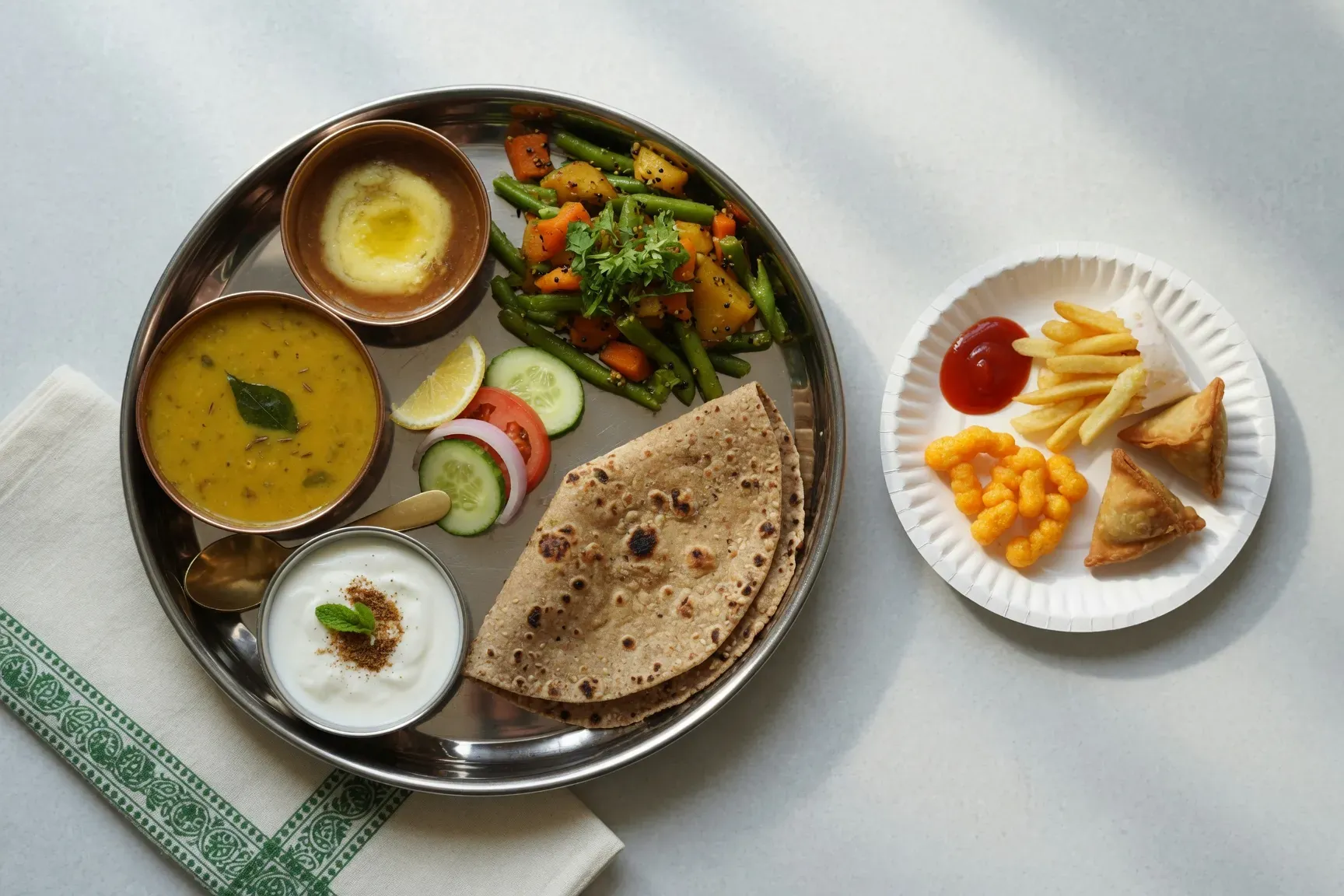
- One cup of dal — approximately 130–150 calories
- One medium banana — approximately 90 calories
- One cup of cooked rice — approximately 200 calories
- One glass of full-fat milk — approximately 150 calories
- A small handful of nuts (30 grams) — approximately 180 calories
- One boiled egg — approximately 75 calories
Three hundred extra calories is not a second meal. It is a meaningful snack, or a slightly larger serving of your regular lunch or dinner. It is the difference between leaving the table comfortably full and leaving it a little earlier because the baby doesn’t seem to need more yet.
This is also the trimester when most women’s appetites return — often with enthusiasm — after the nausea of the first trimester. The reconnection with food after weeks of managing it carefully is a genuine pleasure. The message here is not to dampen that. It is to calibrate: eat well, eat generously, and know that 300 extra calories of nourishing food is a reasonable guide, not a reason to eat sparingly.
Third trimester: a slightly larger increase
In the third trimester, the additional calorie requirement rises to approximately 450 kilocalories per day above pre-pregnancy baseline.
This is when fetal weight gain is most rapid — the baby gains roughly half its birth weight in the last ten weeks of pregnancy — and when your own energy needs for supporting that growth, and for carrying the increased weight of the pregnancy itself, are at their highest.
450 calories is still not a second meal. It is a more substantial snack, an extra serving of dal and rice, or the nutritional equivalent of what a moderately active person would add for a day of extra physical work.
The irony of the third trimester is that this is when eating more becomes physically uncomfortable. As the baby grows, stomach capacity is compressed, heartburn intensifies, and large meals become genuinely difficult. Smaller, more frequent meals are the practical solution — distributing the extra calories across five or six smaller eating occasions rather than three large ones.
What extra calories are not an invitation to eat
The number 300 or 450 extra calories sounds abstract until it’s applied to food choices. It helps to think about where those calories are coming from, because not all extra calories serve pregnancy equally.
Useful extra calories come from:
- Additional dal or legume-based preparation — protein and iron together
- An extra piece of fruit — folate, vitamin C, fibre
- A glass of milk or a serving of curd — calcium, protein, B12
- A small handful of nuts or seeds — healthy fat, protein, minerals
- A ragi preparation — calcium, iron, fibre, slow-release carbohydrate
- An extra roti or small serving of rice with a vegetable and protein — balanced, nourishing
Less useful extra calories tend to come from:
- Commercially produced snacks, biscuits, and fried foods that are calorie-dense but nutritionally thin
- Sugary drinks and juices that provide quick energy but no protein, fibre, or micronutrients
- Very large portions of refined carbohydrate without protein or vegetable accompaniment
This is not about moral hierarchy of foods — occasional biscuits and fried snacks are not going to harm a pregnancy. It is about the practical reality that 300–450 calories of additional food is a small amount, and making it count nutritionally is worth doing.
What about weight gain?
Weight gain in pregnancy is a sensitive topic that deserves a calm and evidence-based approach.
Weight gain during pregnancy is normal, expected, and necessary. The baby, the placenta, the amniotic fluid, the increased blood volume, the expanded uterus, and the maternal fat stores laid down to support breastfeeding are all part of the equation. A pregnancy without weight gain would be a concerning pregnancy.
The general guidance on appropriate weight gain depends on pre-pregnancy BMI, and ranges from roughly 11–16 kilograms for women at a healthy pre-pregnancy weight. Women who began pregnancy underweight may be guided to gain slightly more; women who began pregnancy with a higher BMI may be guided toward the lower end of the range.
Your provider will monitor your weight gain and advise if there are concerns in either direction. The information in this article is not meant to be used for weight management — it is meant to clarify that the “eating for two” idea is not a useful guide to how much to eat, and that modest, quality-focused additions to your pre-pregnancy diet are what the evidence actually recommends.
A note on hunger and appetite
Pregnancy appetite is not linear or predictable. Some days you are hungrier than others. Some trimester experiences don’t match the averages. Some women feel hungry throughout; others continue to struggle with appetite well into the second trimester.
Eating to your hunger — when that hunger is guided by nourishing food choices rather than a continuous craving for one specific thing — is a reasonable approach that doesn’t require counting calories. The calorie numbers in this article are benchmarks for understanding scale, not a tracking target.
If you are genuinely unsure whether you are eating enough during pregnancy — if you are not gaining weight as expected, or if your nausea is severe enough that intake is very limited for an extended period — speak to your provider. These are things worth checking, and your provider can assess them properly.
The honest answer to “how much should I eat?”
A little more than before — specifically in the second and third trimesters. Not twice as much. Not dramatically more. Just a meaningful snack’s worth of extra nourishment per day, chosen for quality, distributed across the day in a way that works with how your body is feeling.
And in the first trimester: eat to your appetite, focus on what stays down and nourishes you, take your prenatal vitamin, and don’t apply the “eating for two” framework to a period of pregnancy when the baby’s caloric demands are genuinely minimal.
That is the honest, evidence-based answer. It is less dramatic than the popular version. But it is far more useful.
This article is for general educational purposes only and does not replace personalised nutrition or medical advice. Always consult your doctor, midwife, or a qualified healthcare professional about appropriate weight gain and calorie intake for your specific pregnancy.