
Ragi During Pregnancy: Why This Kerala Staple Deserves More Attention
Ragi is one of the most nutritionally dense foods for pregnancy — rich in calcium, iron, and fibre. Here's how to eat it in every trimester.
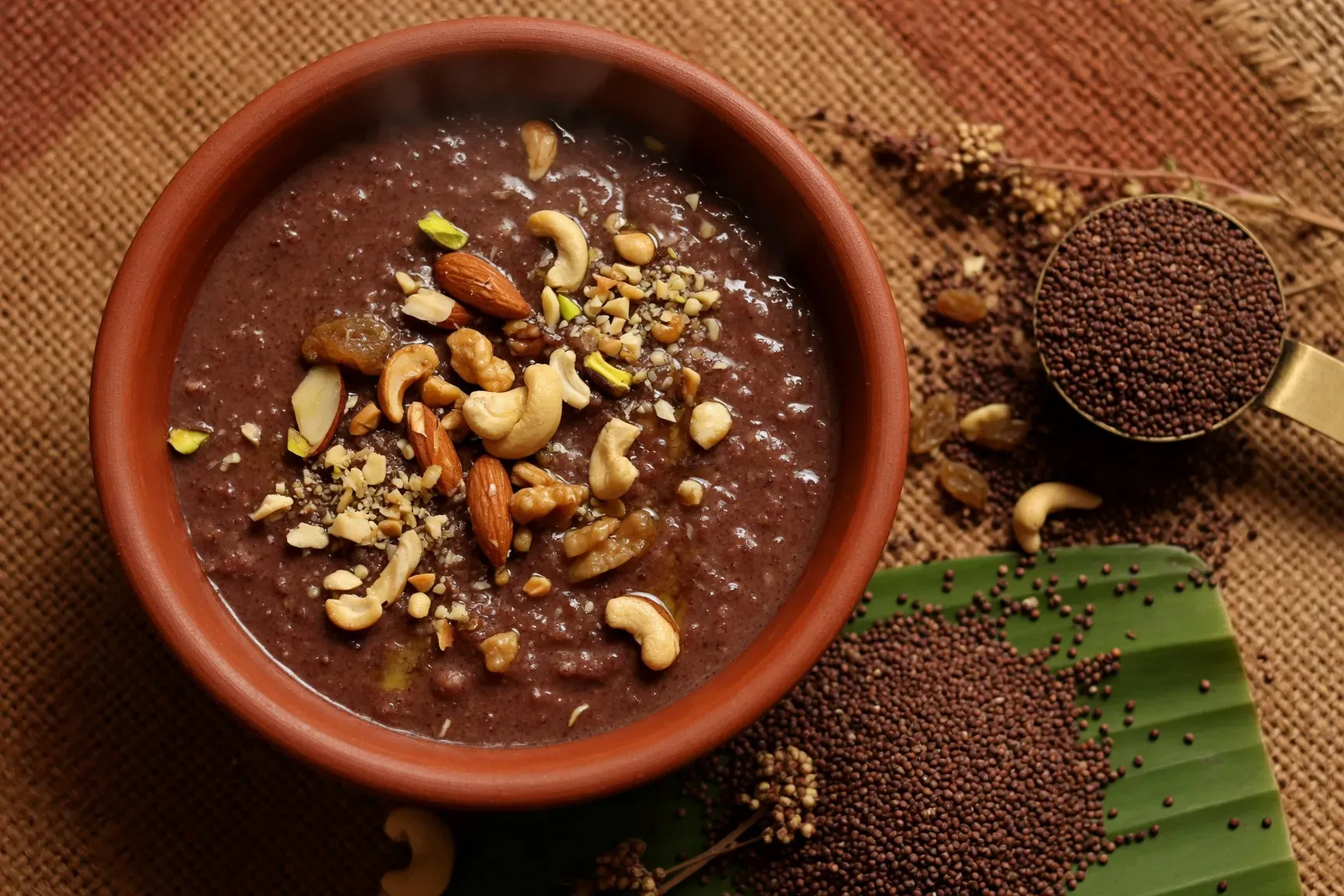
There is a grain that has been grown in the hills of Kerala and across South India for thousands of years, fed to infants, given to recovering mothers, and eaten by farmers as a daily staple — and it is one of the most nutritionally complete foods available for pregnancy.
Ragi, or finger millet, does not get the attention it deserves in modern pregnancy nutrition conversations. The conversation tends to be dominated by supplements, fortified foods, and imported superfoods — which means that something genuinely remarkable, already present in most Kerala kitchens or easily found in any local market, gets overlooked.
If you are pregnant and you are not eating ragi regularly, this article is the case for starting.
What ragi actually contains
The nutritional profile of ragi is worth looking at directly, because it makes the case better than any argument could.
Calcium is where ragi is truly exceptional. Among all grains and cereals, ragi has the highest calcium content — significantly higher than wheat, rice, oats, or maize. For vegetarian and vegan women who are trying to meet pregnancy calcium needs without dairy, ragi is one of the most important foods available. Even for women who eat dairy regularly, ragi provides a meaningful additional contribution.
Iron — ragi is a good source of plant-based iron, contributing to the substantially increased iron needs of pregnancy. Combined with a vitamin C source, its iron is reasonably well absorbed.
Fibre — ragi is high in dietary fibre, particularly a type called insoluble fibre that helps maintain bowel regularity. Constipation is one of the most common discomforts of pregnancy, and ragi — as porridge, as a roti, or as koozh — directly addresses it.
Amino acids — ragi contains methionine, an essential amino acid that is low in most cereal grains. This makes it a more complete protein source than rice or wheat, which matters particularly for vegetarian women.
Magnesium and potassium — both of which support muscle function, blood pressure regulation, and a range of physiological processes that are under additional strain during pregnancy.
Polyphenols and antioxidants — ragi’s outer layer contains antioxidant compounds that have anti-inflammatory properties. Ragi that retains its husk (whole ragi flour rather than refined) has a higher polyphenol content.
Low glycaemic index — ragi causes a slower rise in blood glucose than refined grains, making it a particularly useful food for women managing gestational diabetes or trying to maintain stable blood sugar across pregnancy.
Why calcium from ragi matters specifically in pregnancy
Calcium deserves a moment of expanded attention, because it illustrates why ragi is more than just a traditional food with sentimental value.
During pregnancy, your baby’s skeletal development — bones and teeth — draws calcium steadily from your system. If your dietary calcium intake is insufficient, your body will prioritise your baby’s needs and draw from your own bone stores. This is not hypothetical; it is how the system works. The long-term implication for maternal bone health is a real concern, particularly in populations where calcium intake is already at the lower end.
Ragi porridge eaten two or three times a week provides a meaningful, consistent contribution to calcium intake that requires no supplements, no specially fortified foods, and no changes to how you fundamentally cook. It is whole food calcium in a form that has been supporting South Indian bodies for generations.
For women who are lactose intolerant, who don’t consume dairy regularly, or who are vegetarian and vegan, this matters even more.
The best ways to eat ragi during pregnancy
Ragi koozh (porridge)
This is the most traditional preparation and arguably the most practical for pregnancy — particularly in the first trimester when simple foods are tolerated better than complex ones.
Ragi flour is cooked with water or milk (dairy or plant-based) into a thick porridge. It can be made sweet — with jaggery and a little cardamom — or savoury, with salt, a squeeze of lemon, and buttermilk stirred in. Both versions are nourishing, and both are easy to eat even on days when appetite is unreliable.
The sweet version with jaggery is worth noting specifically: jaggery itself provides iron and minerals that refined sugar doesn’t, so this combination — ragi with jaggery — is genuinely nutritious in a way that most sweet preparations aren’t.
Ragi rotis
Whole ragi flour can be used to make rotis or flatbreads. Because ragi lacks gluten, a small amount of wheat flour is often mixed in to help with binding, or the roti is made thicker and handled carefully while cooking. Ragi rotis work well with dal, with chutney, or with any vegetable preparation that would normally accompany a wheat roti.
Ragi dosa
Ragi flour blended with the usual dosa batter ingredients makes a variation that is darker, slightly nuttier in flavour, and more nutritionally dense than plain rice-based dosa. It can be made thin and crispy or softer depending on preference. This is a useful option in the second and third trimesters when appetite has returned and regular meals are more manageable.
Ragi mudde
A traditional preparation from Karnataka, common in parts of Kerala too — ragi cooked into firm balls that are eaten with sambar or a thin dal. This is a filling, protein-and-calcium-rich meal that is exactly what the second trimester calls for.
Ragi laddoo
A sweet preparation made with ragi flour, ghee, jaggery, and nuts — traditional in many South Indian households as a weaning food and as a postpartum recovery food. During pregnancy, a small ragi laddoo as a snack provides calcium, iron, and slow-release energy without a sugar spike.
Ragi malt
A thinner version of ragi porridge, sometimes with milk added and sweetened with jaggery or honey, served warm or at room temperature. Easy to drink rather than eat, which makes it useful in the first trimester when eating solid food is difficult. Also useful late in the third trimester when smaller stomach capacity means liquid-adjacent meals are easier.
Ragi in each trimester
First trimester
Ragi porridge or malt is one of the best options for difficult eating days. It is bland enough to be tolerable when nausea is making food unappealing, nutritionally substantial enough to actually support you when you’re not managing much else, and gentle enough on a sensitive stomach that most women can keep it down.
The calcium and iron it provides are useful in the first trimester even though the baby’s nutritional demands are still relatively low — because building your own stores early makes the higher demands of later pregnancy more manageable.
Second trimester
This is the trimester to establish ragi as a regular part of your routine. Ragi dosa a few mornings a week, a ragi roti at lunch occasionally, a ragi laddoo as a snack — these are small inclusions that add up to meaningful nutritional support.
The fibre content of ragi is particularly welcome as digestive sluggishness increases in the second trimester. Unlike fibre supplements, ragi fibre comes with calcium, iron, and protein as part of the same package.
Third trimester
As stomach capacity reduces and heartburn increases, ragi porridge and ragi malt come back into their own — easy to eat in smaller amounts, nutritionally dense enough that a smaller portion still counts for something.
Ragi’s low glycaemic index also matters increasingly in the third trimester, when insulin sensitivity can shift and maintaining stable blood sugar becomes more important.
A note on ragi and sprouting
Sprouting ragi before making flour from it is a traditional practice that significantly improves its nutritional profile. Sprouting reduces phytate content — the compounds that inhibit mineral absorption — which means the iron and calcium in sprouted ragi are more bioavailable than in unsprouted ragi. Sprouted ragi flour is available in many health food stores and larger supermarkets, and it’s worth using when you can find it.
If sprouted flour isn’t available, soaking ragi flour briefly before cooking still reduces phytate content to a meaningful degree.
Is ragi safe throughout pregnancy?
Yes. Ragi is a whole grain food with no known adverse effects in pregnancy. The concerns that circulate about ragi in pregnancy are largely without evidence — they tend to arise from generalised caution about “heavy” or “heating” foods rather than from any specific property of ragi itself.
The traditional understanding of ragi as a recovery and nourishment food — given to new mothers, to infants, and to people who are unwell — reflects generations of observed benefit. Modern nutritional analysis confirms what traditional practice has long known: this is a food that supports the body through demanding periods. Pregnancy is exactly that kind of period.
What good ragi nutrition looks like in pregnancy
It doesn’t mean eating ragi every single day or making it the centrepiece of every meal. It looks like:
A ragi porridge a few mornings a week. A ragi roti or dosa when you feel like it. A ragi laddoo as a snack when something sweet and filling is what you want. A ragi malt on mornings when solid food isn’t happening.
That’s enough. That’s the kind of consistent, low-effort inclusion that adds genuine nutritional value across forty weeks — which is exactly what good pregnancy nutrition is supposed to look like.
This article is for general educational purposes only and does not replace personalised nutrition or medical advice. Always consult your doctor, midwife, or a qualified healthcare professional about your specific dietary needs during pregnancy.