Keeping a Pregnancy Journal: What to Write and Why It Helps
A gentle guide to pregnancy journaling — what to write, how to start, different formats for different personalities, and why the act of recording the experience matters for both the present and the future.
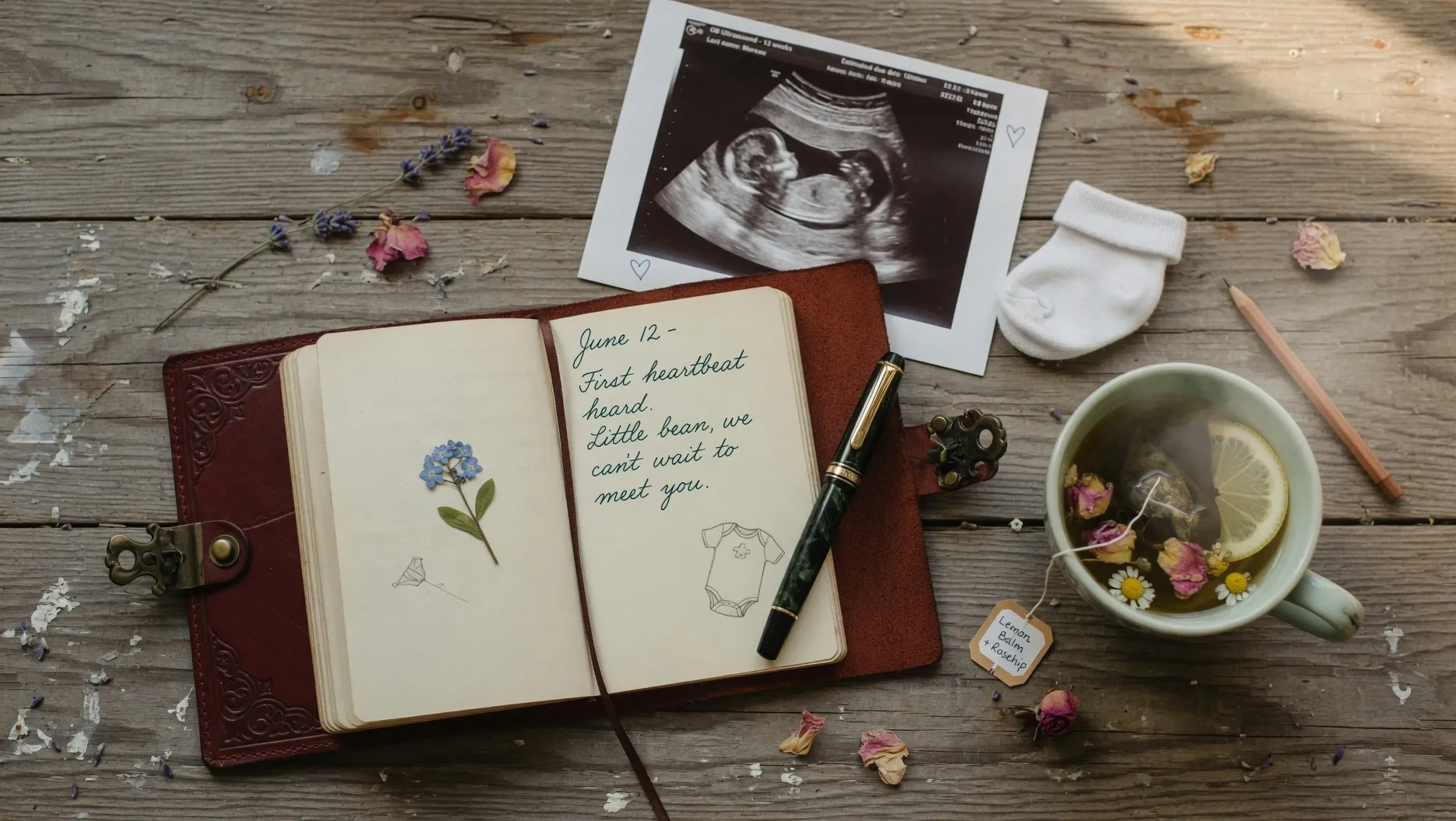
Pregnancy is forty weeks of extraordinary experience that passes in a blur. The specific feeling of the first kick at week 19. The appointment where you heard the heartbeat for the first time. The dream you had in the third trimester that you still remember vividly. The precise way the anxiety felt in the first trimester, before the early scan, when you were holding the whole thing lightly because you were afraid to hold it fully.
These things become hazy quickly — not because they weren’t significant but because new experiences replace them, because sleep deprivation arrives and with it a kind of fog over the months that preceded it, because the baby who is in your arms rapidly becomes more real than the baby who was in your body.
A pregnancy journal preserves what would otherwise be lost. Not for anyone else’s benefit — for yours, and eventually for your child’s.
Why journaling helps beyond preservation
The benefit of pregnancy journaling is not only the record it creates. The act of writing itself has functional value during pregnancy that is independent of what you re-read later.
Externalising anxiety. Writing about what you are worried about — putting it outside your head and onto a page — reduces the cognitive load of carrying it. Research on expressive writing consistently shows that people who write about their worries experience less preoccupation with those worries than those who only think about them. This is particularly relevant in a period when anxiety is elevated and sleep disruption makes the mind feel less manageable.
Processing the transition. Pregnancy is a period of enormous identity change — not just the addition of a new role but the genuine ending of a previous phase of life and the beginning of something wholly new. Writing about that transition — what you are leaving behind, what you are moving toward, what you are afraid of, what you are hoping for — supports psychological integration in a way that staying in the rush of daily life does not.
Creating communication with your future child. Many pregnancy journals become something offered to the child — not necessarily the raw anxiety entries, but the love, the anticipation, the specific way their parent thought about them before they arrived. This is a form of communication across time that a photograph cannot replicate.
What to write
There is no required format or required content. The most useful journals are the ones that are actually written in — imperfectly, irregularly, honestly — rather than the ones that are beautiful but blank.
Some approaches to what to write:
Weekly entries. A brief entry once a week that covers how you are feeling, what the baby is doing, what happened this week that mattered, and what you are thinking about. Structured enough to maintain consistency, brief enough to actually do.
Symptom and experience documentation. Not the clinical symptom log you might keep for your doctor, but the personal experience version — not “nausea, 7/10 severity” but “I couldn’t be in the kitchen when anything was cooking and spent two mornings lying on the bathroom floor because the smell of oil was unbearable. I ate only crackers and mango for a week and somehow the baby is fine.”
Letters to the baby. Writing directly to the baby — addressing them as a person you are coming to know — is a practice that many pregnant women find surprisingly natural and emotionally clarifying. You can write about what you hope for them, what you want them to know about the world, what the world looked like in the year they were born, who you are as a person and who you are becoming as their parent.
Processing entries. Unstructured, free-writing entries when something feels large — anxiety about a scan result, a difficult conversation with family, a moment of unexpected joy, the first time you felt them move and what that was like. These entries do not need to be coherent or complete.
Practical notes. Appointment summaries, questions you thought of between appointments, things you want to remember to discuss. These have functional value and belong in the journal as much as the emotional entries.
Different formats for different personalities
Physical notebook. A dedicated notebook — nothing fancy, though some people find beauty in the object motivating — kept by the bed or at the desk where you spend time. The physical act of writing has a different quality from typing and may suit people who find screens activating rather than calming.
Notes app or document. For people who live on their phones and would not realistically keep a physical notebook. Lower barrier to actually writing, though less archive-quality.
Voice memos. Speaking rather than writing — recording a brief voice note when a thought arrives that you want to keep. This is the lowest-friction option and suits people who find writing laborious.
App-based journaling. Mommy: Pregnancy Care & Guide includes notes and tracking features that can serve as a structured pregnancy journal within the app context, keeping everything in one place.
Starting when you haven’t started
If you are already several weeks or months into a pregnancy and have not been journaling — start now. You have not missed the beginning in any meaningful way. What you remember of the first trimester, even imperfectly, is worth writing down now. The second trimester has its own things to record. The third trimester is full of material.
There is no point at which starting is not worthwhile.
This article is for general educational and inspirational purposes. There is no right way to keep a pregnancy journal — the only rule is that it should be genuinely yours.