
Preparing Your Older Child for a New Baby: Age-by-Age Guidance
A practical guide to preparing your older child for a new sibling — what children understand at different ages, how to talk about the pregnancy, and how to manage the transition after the baby arrives.
When you are pregnant with your second or subsequent child, your older child exists in your mind as a constant consideration — you wonder how they will respond, whether they will feel displaced, whether you are doing enough to prepare them, whether the new sibling will damage something in the first child that you have worked hard to build.
These are real concerns. They are also, in most cases, more manageable than they feel in anticipation. Children are more adaptable than we give them credit for, and the quality of the transition depends less on what you say in advance and more on the quality of attention, consistency, and security you provide through the process.
That said, preparation matters — and how you approach it should be calibrated to your child’s age and developmental stage.
Toddlers (under 2 years)
Children under two have limited ability to understand what a sibling means in any abstract sense. They do not have the cognitive framework to imagine a new person joining the family, to anticipate change, or to prepare emotionally for something months in the future.
What this means in practice: very early introduction of the concept (early in the pregnancy) is not necessary and may create confusion. A month or two before the due date is sufficient for a toddler — close enough to the actual event to be meaningful, not so early that the concept is incomprehensible.
How to talk about it: concretely and simply. “There is a baby growing in Mama’s tummy. When the baby comes out, the baby will live with us.” Show pictures of babies. Let them feel the bump when the baby moves. Keep language simple and positive.
What matters more than explanation: maintaining your toddler’s routines as consistently as possible during the pregnancy and after the birth. Toddlers read security through routine, and disruption to routine is the most significant thing they register. Where changes are necessary — a move to a different room, a change in bedtime routine — implement them well before the birth rather than at the same time.
After the birth: give the older child something specific to do with the new baby — a simple task that makes them a helper rather than a bystander. Protect one-on-one time with the older child every day, even if brief.
Preschoolers (2–4 years)
Preschoolers are old enough to understand the concept of a baby coming but young enough to have a concrete and often very personal reaction to what it means for them. The primary concern of a preschooler about a new sibling is frequently: will I still be loved? Will I still get attention? Will the baby take my things, my parents, my place?
These concerns are legitimate and should be addressed directly rather than bypassed.
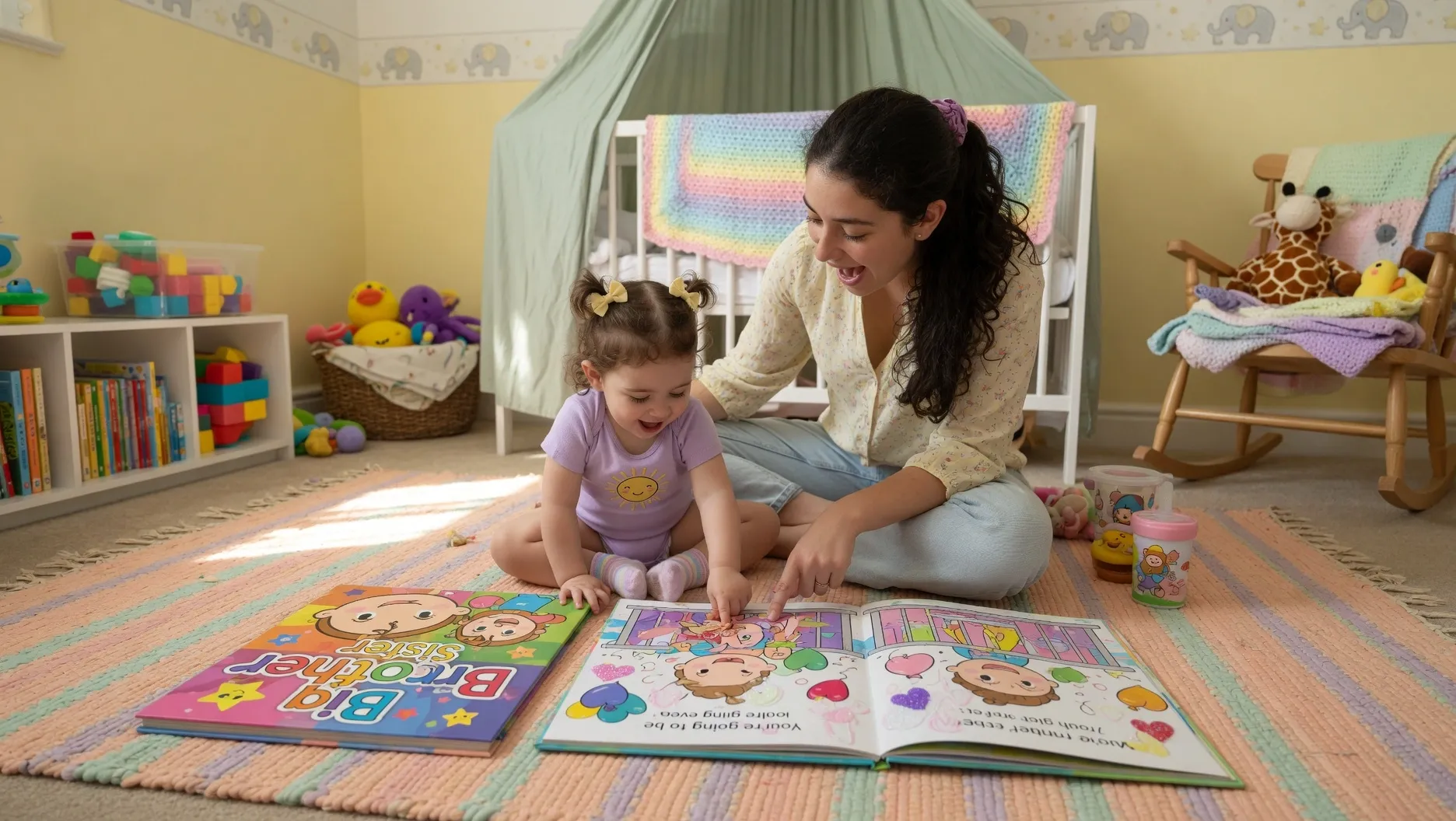
How to talk about it: you can introduce the pregnancy earlier with a preschooler — once the pregnancy is visible or the family has chosen to share. Use concrete language and picture books about new siblings. Involve them in age-appropriate ways: feeling the baby move, choosing a small gift for the baby, helping set up the nursery.
Address the displacement fear directly: “The baby is going to need a lot of attention when they are very small. You might sometimes feel left out. When that happens, tell me and we will find time to be together.” This kind of direct acknowledgement — naming the experience before it happens — reduces the child’s sense that the feeling is unacceptable.
Prepare them for what a newborn is actually like: a baby cannot play, cannot talk, cries a lot, needs constant care. Preschoolers who expect a playmate and receive a crying, sleeping, feeding newborn sometimes experience significant disappointment. Honest, concrete preparation for what the baby will actually be like is protective.
After the birth: a small gift “from the baby” to the older child at the first meeting — a book, a small toy — is a tradition many families find genuinely helpful. The older child’s first meeting with the sibling goes better when it is not only about what the child is expected to feel toward the baby but includes something for them.
Early school age (5–7 years)
Children in this age range understand considerably more about pregnancy, birth, and family change than younger children. They can follow an explanation, ask real questions, and begin to anticipate what the change will mean for their life.
How to talk about it: more fully and with more information. They can understand what the pregnancy is, what birth involves at an age-appropriate level, and what the family’s plan is for when the baby comes — who will care for them when you go to hospital, what will be different, what will stay the same.
Involve them in conversations about the baby. Ask their opinions about things they can genuinely participate in — names if appropriate, nursery colour, what to tell their friends. Feeling consulted rather than informed after the fact matters to this age group.
Be honest about the challenges: “It’s going to be hard sometimes. The baby will cry a lot and need a lot of attention. There might be times when you feel impatient with that, and that’s okay.” Normalising the difficult feelings in advance makes it easier for the child to bring them to you when they arise rather than managing them alone.
After the birth: their role with the baby can be more active. Reading to the baby, helping with small care tasks, explaining things about the world — all of this gives them a meaningful relationship with the sibling rather than positioning them as an observer of something being done for someone else.
Older children (8 years and above)
Older children can understand the pregnancy fully, participate in family decisions meaningfully, and have an adult-adjacent conversation about what is coming. They also have more established identities, routines, and social lives that the new baby will affect differently than it affects younger children.
How to talk about it: honestly and respectfully. They deserve to know what is happening, what the plan is, and how their specific routines and circumstances might be affected. Be transparent about the challenges as well as the positives — older children have well-developed radar for when they are being managed rather than genuinely included.
Ask about their feelings rather than assuming them. An eight-year-old who expresses ambivalence about the new baby is not failing to love appropriately — they are being honest about something complex. Receiving that honesty without pressure or correction is more important than securing enthusiastic acceptance.
After the birth: the older sibling can be a genuine help with the baby — older children can hold the baby, help entertain them, assist with simple care tasks. Being needed by the family during the adjustment period gives meaning to the transition and reduces the sense of displacement.
This article is for general educational and informational purposes. Every child responds differently, and the support that helps most will depend on your child’s individual temperament, developmental stage, and relationship with you.