Prenatal Yoga in Kerala: A Beginner's Guide to Safe Poses by Trimester
A practical, trimester-by-trimester guide to prenatal yoga for women in Kerala — what is safe, what to avoid, and how to adapt familiar poses to a changing body.
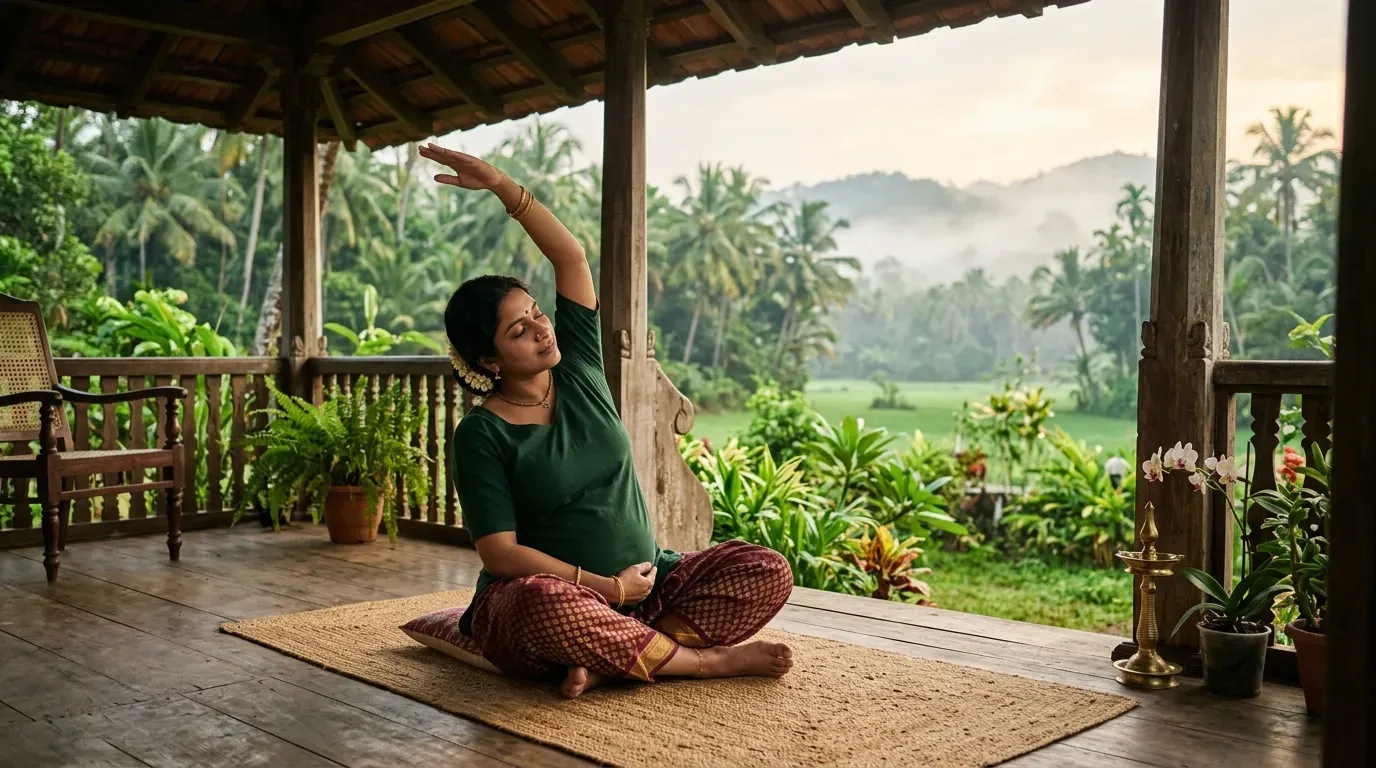
Yoga has a long and grounded history in Kerala — through Kalaripayattu traditions, through Ayurvedic practice, and through the growing presence of yoga studios and community classes across the state. For pregnant women, yoga offers something specific and valuable: a form of movement that attends to both the body and the breath, that builds the strength and flexibility that labour benefits from, and that creates a regular space of physical and mental quietness in what is often a physically and emotionally demanding experience.
Prenatal yoga is not ordinary yoga with the belly accommodated. It is a distinct practice that works with the changing body of pregnancy — its expanding centre of gravity, its loosening ligaments, its increased sensitivity — and that deliberately builds toward the specific physical demands of labour and early motherhood.
This guide is for women who are new to yoga and want a clear, safe starting point, and for those who already practise yoga and need to understand what changes as the pregnancy progresses. It is organised by trimester because the body’s needs — and its limitations — shift significantly across the forty weeks.
Before you begin: what your provider needs to know
Yoga is safe for most uncomplicated pregnancies, but it is not universally appropriate without modification. Before beginning a prenatal yoga practice, confirm with your provider that there are no specific contraindications in your case.
Conditions that may require modified or avoided yoga practice include:
- Placenta praevia (low-lying placenta)
- Preterm labour risk or history
- Severe anaemia
- Pregnancy-induced hypertension or preeclampsia
- Incompetent cervix or cervical stitch (cerclage)
- Significant cardiovascular or respiratory conditions
If any of these apply to you, your provider’s specific guidance takes precedence over anything in this article.
For uncomplicated pregnancies, the general guidance from obstetric organisations is that moderate exercise, including yoga, is safe and beneficial throughout pregnancy.
The principles that apply across all trimesters
Breath is the anchor. In prenatal yoga, the breath takes on greater importance than in a general yoga class. Deep, diaphragmatic breathing — expanding the belly with the inhale, releasing with the exhale — activates the parasympathetic nervous system, reduces cortisol, and provides the foundational breathing practice that will be genuinely useful in labour. Return to the breath whenever a pose becomes uncomfortable or uncertain.
Never compress the abdomen. Prone positions (lying face-down), deep forward folds that press the abdomen, and twists that compress rather than lengthen the abdominal area are modified or avoided in pregnancy.
Avoid lying flat on the back after the first trimester. From approximately sixteen to twenty weeks onward, lying on the back allows the weight of the uterus to compress the inferior vena cava — the large vein that returns blood from the lower body to the heart. This can reduce blood pressure and compromise blood flow. Poses that require lying on the back are modified to a left-side lying position or a supported reclined position with a wedge under the right hip.
Avoid deep, unsupported backbends. The hormone relaxin, which softens the ligaments throughout pregnancy to allow the pelvis to expand for birth, also reduces joint stability throughout the body. Deep backbends that rely on ligament restriction for safety become more risky in pregnancy. Supported, gentle backbends that open the chest are appropriate; deep unsupported backbends are not.
Stop if something hurts. Discomfort is different from pain. A gentle stretch, a mild muscle effort, a feeling of warmth in working tissue — these are appropriate sensations in yoga. Pain, sharp sensations, dizziness, breathlessness, or vaginal pressure are not. Stop, rest, and assess before continuing. If pain persists, contact your provider.
Keep the heart rate moderate. Pregnancy increases the cardiovascular demand of any activity. In prenatal yoga, the pace is slower than in a general flow class, and there is no ambition toward maximum effort. The breath should remain comfortable throughout — if you cannot hold a light conversation, the intensity is too high.
Use props generously. Blocks, bolsters, folded blankets, a chair, a wall — these are not signs of inadequate practice. They are how prenatal yoga makes poses accessible and safe across the rapidly changing geometry of a pregnant body. A well-equipped practice space is one with options.
First trimester (weeks one to thirteen)
The first trimester is often the most physically challenging of the three, not because of the size of the belly — which is minimal — but because of fatigue, nausea, and the significant hormonal adjustment happening internally. Yoga in the first trimester should be gentle, short, and responsive to how you feel on any given day.
What the body needs in the first trimester:
- Rest as much as movement
- Gentle stretching for the fatigue-tightened body
- Breathing practices to manage nausea and support the nervous system under hormonal pressure
- Grounding and gentle inversions are generally fine at this stage (the uterus is still well below the navel and abdominal pressure is minimal)
Poses appropriate for the first trimester:
Sukhasana (easy cross-legged seat) with conscious breathing. The simplest starting point. Sit cross-legged on a folded blanket (elevating the hips above the knees reduces strain on the lower back and hips). Place the hands on the knees or on the belly. Breathe slowly and fully — expanding into the belly and the ribs. This is the foundation of the practice and valuable at any trimester.
Cat-cow (Marjaryasana-Bitilasana). On all fours with the wrists under the shoulders and knees under the hips. On the inhale, drop the belly, lift the gaze, extend the tailbone (cow). On the exhale, round the spine upward, tuck the chin and the tailbone (cat). This gentle spinal mobilisation relieves the tension that builds in the lower back and relieves nausea for many women through its gentle compression and release of the abdomen.
Gentle standing poses — Tadasana (mountain pose) and Virabhadrasana I (Warrior I). Standing poses build the postural awareness and lower body strength that pregnancy increasingly demands. In the first trimester they can be practised largely as in a non-pregnant class; use a wall for balance support if fatigue affects stability.
Baddha Konasana (bound angle / butterfly pose). Sitting with the soles of the feet together and the knees falling outward. This opens the inner thighs and hips — areas that carry significant tension in pregnancy and that benefit from regular, gentle release. Support the knees with blocks or rolled blankets to reduce the stretch intensity if the hips are tight.
Child’s pose (Balasana) — wide-legged variation. Kneel with the knees wide apart (wider than in the standard pose, to accommodate the belly even in the first trimester) and fold forward, arms extended or alongside the body. Rest the forehead on the floor or on stacked hands or a block. This is one of the most restorative poses in prenatal yoga and can be used as a resting point at any stage of the practice.
Legs up the wall (Viparita Karani). Lying on the back with the legs resting up the wall, the pelvis near the wall’s base. This drains fluid from the lower limbs, rests the cardiovascular system, and is gently calming. In the first trimester it is safe; from around sixteen weeks, use a folded blanket or wedge under the right hip so the pelvis is slightly tilted rather than flat, to reduce vena cava compression.
What to avoid or approach cautiously in the first trimester:
- Very hot yoga / Bikram yoga — the overheating risk is real and the first trimester is when the baby’s neural tube formation occurs, making hyperthermia particularly relevant
- Intense inversions (headstand, shoulderstand) if you are not already an experienced practitioner — the first trimester is not the time to begin
- Deep twists that compress the abdomen
Second trimester (weeks fourteen to twenty-seven)
The second trimester is often the most comfortable period for yoga practice. Nausea has typically settled, energy has partially returned, and the bump, while growing, has not yet reached the size that significantly limits movement. This is the trimester to build a consistent practice.
The centre of gravity is shifting, and relaxin is well established, which means balance and joint stability require more attention. Poses that were straightforward before pregnancy may require modification.
Poses appropriate for the second trimester:
Warrior II (Virabhadrasana II). A foundational standing pose that builds strength in the quadriceps, glutes, and inner thighs — all of which are working harder as the body adapts to the changing weight distribution of pregnancy. Stand with legs wide apart, turn one foot out and bend the knee over the ankle, arms extended in a T-shape. Use a chair alongside if balance is uncertain. This pose builds the leg strength and hip stability that will support the body through the increasing demands of the third trimester.
Triangle pose (Trikonasana). Feet wide apart, one foot turned out. Extend one arm toward the floor (use a block if the floor is not reachable), the other arm toward the ceiling. This opens the side body, stretches the hamstrings and inner groin, and creates space in the torso. The triangle shape of the wide stance accommodates the growing belly naturally.
Goddess pose (Utkata Konasana). Wide-legged squat with the feet turned out and the knees bent, arms in a cactus shape or hands on thighs. This builds strength in the hips, inner thighs, and lower body — and begins the practice of the squatting position that many women find helpful during labour. Start with a shallow squat and deepen gradually as strength and hip mobility improve.
Supported pigeon pose. From all fours, bring one knee forward and to the side, extending the other leg back. The classic pigeon requires the front shin to be parallel to the mat, which may not be accessible — modify with the foot closer to the hip, and use a folded blanket under the hip of the front leg for support. This opens the external hip rotators and piriformis — areas that carry significant tension in pregnancy, particularly when sciatic pain is present.
Side-lying savasana (final relaxation). Replace flat-on-the-back savasana with a left-side lying position, with a pillow or bolster between the knees. This is the modified resting position for the second and third trimesters and is as restorative as the traditional flat savasana when you have settled into it.
Malasana (garland / deep squat). Feet wider than hip-width, toes turned out, heels on the floor (use a rolled blanket under the heels if they don’t reach the floor). This is one of the most valuable poses in prenatal yoga — opening the hips and pelvis, lengthening the pelvic floor, and familiarising the body with a position that has been used for labour and delivery across cultures and generations. Do not force depth; use a block or low stool under the buttocks for support.
What to begin avoiding in the second trimester:
- Flat-on-the-back poses for more than brief moments (use the left-side or wedge-supported variation)
- Deep twists (adapt to open twists — spiral from the mid-back upward without compressing the belly)
- Prone poses (lying face-down)
- Poses that require significant balance on one leg without wall or chair support
Third trimester (weeks twenty-eight to forty)
The third trimester asks the body to adapt to a size and weight distribution that changes week by week. The priority shifts from building strength and flexibility to maintaining comfort, preparing the body and breath for labour, and finding rest. Many women find that the third trimester’s practice becomes slower, more supported, and more focused on breathing and release than on strength-building.
Poses appropriate for the third trimester:
All-fours positions — cat-cow, table-top balance, and hip circles. Being on all fours relieves the weight of the belly from the spine and pelvis, reduces lower back pressure, and encourages the baby into an optimal anterior position. Spending time in all-fours positions in the third trimester — during yoga but also in everyday life — is one of the most consistently recommended things for this stage. Hip circles (drawing large circles with the pelvis while on all fours) are a favourite for their relief of pelvic discomfort and their preparation of the hip joints for labour.
Supported squatting against a wall. Back against the wall, feet hip-width or slightly wider, sliding down into a squat with the wall supporting the back. Use as much wall support as needed. Hold for five to ten breaths. This builds the endurance for the squatting positions that many women use during labour and that may facilitate delivery by opening the pelvic outlet. Squatting on the floor with blocks or a bolster under the buttocks is an alternative.
Butterfly pose with movement. Sitting with soles of the feet together, gently bouncing the knees up and down or circling them slowly. This rhythmic movement in the inner groin and pelvic area is soothing and helps release the holding that builds in this area through the third trimester.
Supported reclined bound angle (Supta Baddha Konasana). Lying back over a bolster or stack of folded blankets (so the torso is inclined at approximately thirty to forty-five degrees rather than flat), with the soles of the feet together and the knees falling outward, supported by blocks. This is one of the most restorative positions in pregnancy — supported, comfortable, and opening the chest and groin simultaneously.
Ujjayi breathing and extended exhale practice. The breath becomes the primary focus of third-trimester practice. Ujjayi breath — a gentle constriction at the back of the throat that creates a soft oceanic sound in the breath — is used in labour by many yoga practitioners to manage the intensity of contractions. Practising it during comfortable yoga sessions builds the familiarity that makes it available under pressure. Extended exhale breathing (longer exhale than inhale) activates the parasympathetic nervous system — the same system you will need access to during labour.
Legs up the wall (with hips elevated). With a folded blanket under the right hip and legs resting up the wall. This remains one of the most useful restorative positions in the third trimester for the swollen feet and legs that are almost universal at this stage.
What the third trimester practice generally moves away from:
- Standing balances without wall or chair support
- Strong backbends
- Any pose that produces pelvic girdle pain or pubic symphysis pain
- Any position that feels like the baby is pressing into the diaphragm uncomfortably — modify the incline and the angle until comfortable
Finding a prenatal yoga class in Kerala
A qualified prenatal yoga teacher — specifically trained in prenatal yoga, not simply a yoga teacher who is comfortable with pregnant students — is the ideal guide for this practice. Prenatal yoga teacher training covers the physiological changes of pregnancy, contraindications, modifications, and the specific demands of each trimester in ways that general yoga teacher training does not.
Prenatal yoga classes are increasingly available in Thiruvananthapuram, Kochi, Kozhikode, and other major urban centres in Kerala. Online prenatal yoga classes — accessible across smaller towns and rural areas where in-person classes may not be available — have expanded significantly and can be a good alternative when local classes are not accessible.
If you join a general yoga class rather than a prenatal-specific one, inform the teacher of your pregnancy before class begins. A good teacher will offer modifications; if they are not familiar with pregnancy modifications, a prenatal-specific class or online resource is safer.
The honest message
Prenatal yoga is not a performance. It is not about achieving the most impressive pose or maintaining the most demanding practice through a pregnancy. It is about showing up regularly — three times a week is enough — in a space that is slow, attentive, and honest about what the body needs right now.
The breath you practise on the mat is the breath you will return to in labour. The strength in the legs and hips you build across the trimesters will support you when you need it. The familiarity with your own body — its signals, its edges, its extraordinary capacity — is something that yoga specifically builds, and that pregnancy specifically rewards.
Come to the mat in whatever shape you are in today. That is enough.
This article is for general educational purposes only and does not replace personalised medical advice. Always consult your doctor, midwife, or a qualified healthcare professional before beginning or continuing any exercise programme during pregnancy. Work with a qualified prenatal yoga teacher where possible.