C-Section in India: What to Expect Before, During, and After
A comprehensive, honest guide to caesarean section in India — the preparation process, what happens during the operation, recovery expectations, and how to advocate for yourself before and after a C-section.
India has one of the highest caesarean section rates in the world — the national rate is approximately 17%, but in private hospitals in urban areas it is significantly higher, with some facilities reporting rates of 40–60%. Whatever the reason for the high rate — and the reasons are complex and contested — the practical reality is that a significant proportion of women giving birth in Indian hospitals will have a caesarean section, either planned or unplanned.
Despite its prevalence, the C-section is frequently discussed as if it were an exceptional event rather than the way one in five or more Indian babies are born. This guide treats it as what it is: a major surgical procedure that deserves thorough understanding, preparation, and honest expectation-setting.
When a C-section is recommended
Planned (elective) C-section — scheduled before labour begins for a specific medical indication:
- Placenta previa (placenta covering the cervix)
- Transverse or oblique baby position at term
- Certain maternal health conditions
- Previous C-section with contraindications to vaginal birth
- Twin or multiple pregnancy in specific configurations
- Baby’s size or position presenting a specific risk
Emergency C-section — performed during labour when circumstances require rapid delivery:
- Prolonged labour that is not responding to augmentation
- Fetal distress — signs that the baby’s wellbeing is compromised
- Placental abruption
- Cord prolapse
- Failed instrumental delivery
Not all C-sections in India are for clinical indications. If you are being advised a C-section, you are entitled to ask: what is the specific indication for this? What are the risks if I wait or attempt vaginal birth? This is not confrontational — it is informed consent.
Before the operation
For a planned C-section:
You will be asked to fast from food and clear fluids for a specified period before the operation — typically 6 hours for food and 2 hours for clear fluids. This is to reduce the risk of aspiration under anaesthesia.
Pre-operative blood work, an IV line, and a urinary catheter will be placed before you go to the operating theatre. The catheter allows the bladder to be drained during and after the operation — it is typically removed 24 hours after surgery.
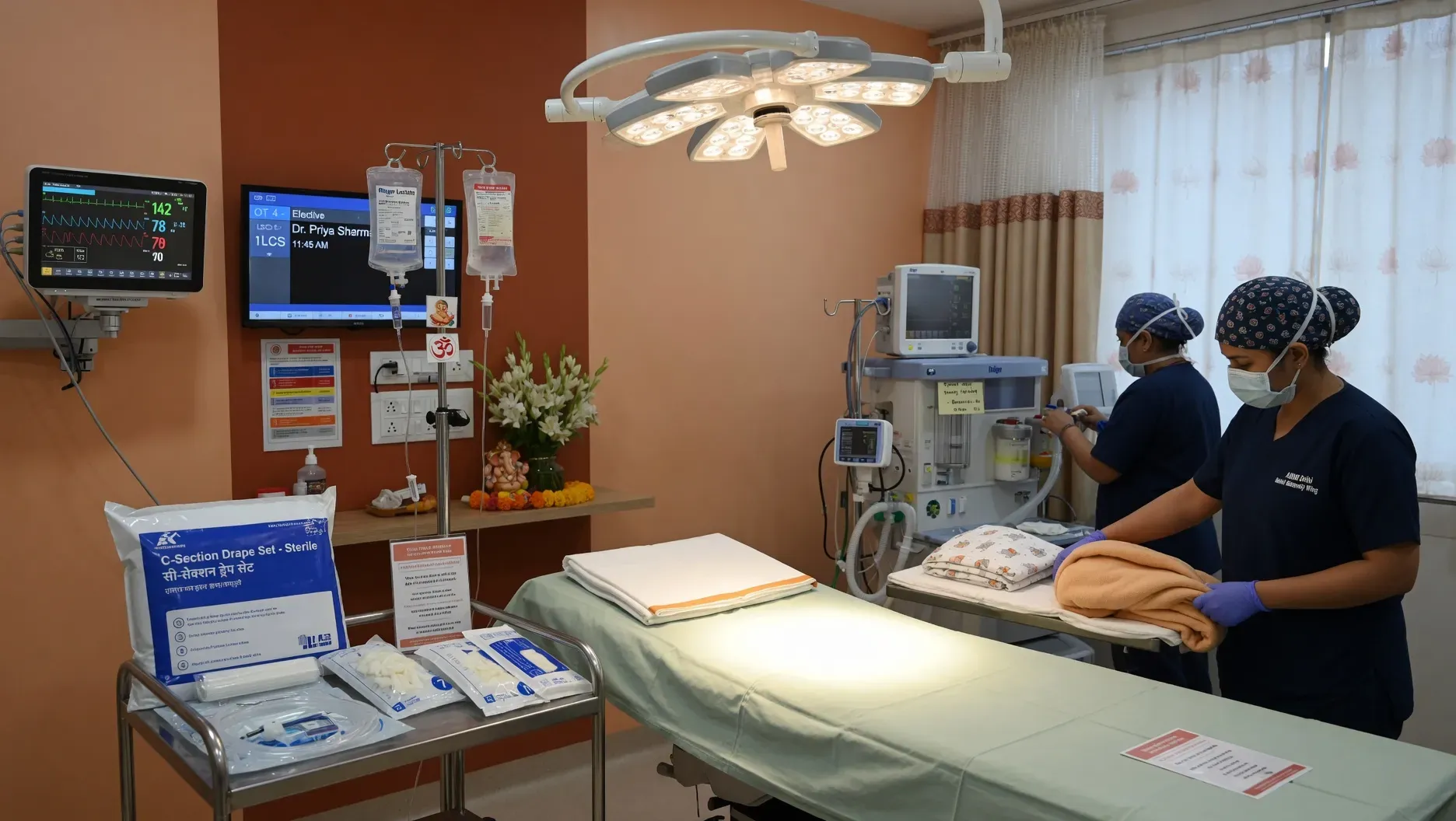
You will change into a hospital gown. The abdomen will be cleaned and shaved if necessary. You will be moved to the operating theatre, which will feel significantly colder and more clinical than the labour ward.
Anaesthesia: Most planned and non-emergency C-sections in India are performed under spinal or epidural anaesthesia — you remain awake but have no sensation from the chest down. You will feel pressure and movement but not pain. General anaesthesia is reserved for emergencies where spinal/epidural is not possible.
Your partner may or may not be allowed in the operating theatre — this varies by hospital. Ask specifically when you are planning.
During the operation
The operation takes approximately 45 minutes to 1 hour, though the baby is typically delivered in the first 5–15 minutes. The remainder of the time is spent delivering the placenta and closing the incisions in layers.
What you will experience: a sensation of pressure and pulling when the baby is being delivered, the baby’s cry (if the baby cries immediately), the option to see the baby being lifted out if the screen is lowered, and a quiet period of suturing after the baby has been removed.
The incision is almost always a transverse (horizontal) cut just above the pubic hairline — the bikini line incision. This heals with a relatively inconspicuous scar in most cases.
The baby will be assessed by a paediatrician in the room. If the baby is well, they can be placed on your chest for skin-to-skin contact as soon as is practically possible — this is worth requesting explicitly in advance.
Immediate recovery
You will be moved to a recovery area for monitoring as the anaesthesia wears off. As sensation returns to the lower half of your body, you may feel shivering (a normal response to spinal anaesthesia), pain in the incision area (managed with IV or oral pain medication), and nausea (also common and manageable with medication).
The catheter will drain your urine automatically. You will have an IV line providing fluids.
Pain management in the immediate post-operative period should be proactive — ask for pain medication when the anaesthesia is wearing off and before the pain becomes severe. Well-managed pain in the first 24 hours makes early movement easier, and early movement is important for recovery.
Recovery in hospital
Most women stay in hospital for 3–5 days after a C-section. During this time:
Early movement is important and will be encouraged. This is often the most counterintuitive aspect of C-section recovery — you have had major surgery and want to lie still, but getting up and moving (supported and carefully) on the first day significantly reduces the risk of blood clots, supports bowel recovery, and begins the healing process. The first time you get up will be difficult. It gets easier.
The wound will be dressed and monitored for infection signs. Keep the incision area clean and dry. Report increasing pain, redness spreading from the wound edges, fever, or discharge.
Breastfeeding is possible and encouraged. A C-section does not prevent breastfeeding, though the position may need adjustment — lying on the side or the football hold (baby tucked under the arm) reduces pressure on the incision. Milk coming in may be slightly delayed compared to vaginal birth in some cases, but breastfeeding absolutely remains possible.
Recovery at home — the realistic version
Recovery from a C-section takes longer than many women are prepared for. The first six weeks are the critical healing period.
Do not lift anything heavier than your baby for six weeks. This is the most important restriction, and the one most commonly violated. The internal layers of the incision are still healing and lifting heavy loads risks disruption of the wound and hernia formation.
Drive only after you can perform an emergency stop without pain. In practical terms, most women wait at least six weeks before driving.
The scar will be tender, numb, or itchy as it heals. This is normal. The numbness may persist for months and sometimes permanently, as nerves regenerate slowly.
Fatigue will be significant — more than you might expect, because the blood loss of surgery, the anaesthetic, and the demands of newborn care combine with your body’s healing process. Accept help. Rest when the baby rests. Reduce domestic obligations to the minimum possible.
Pain management at home — your hospital will discharge you with pain medication. Take it on schedule rather than waiting until pain is severe — pain that is well controlled makes moving and feeding the baby easier, which accelerates recovery.
This article is for general educational purposes only. If you have specific questions about a C-section that is planned or has been recommended for your pregnancy, discuss them with your obstetrician.