
Birth Plans in India: What They Are, Why They Help, and How to Write One
A practical guide to birth plans for Indian hospitals — what to include, how to communicate preferences to your care team, and how to hold your plan lightly when labour doesn't follow the script.
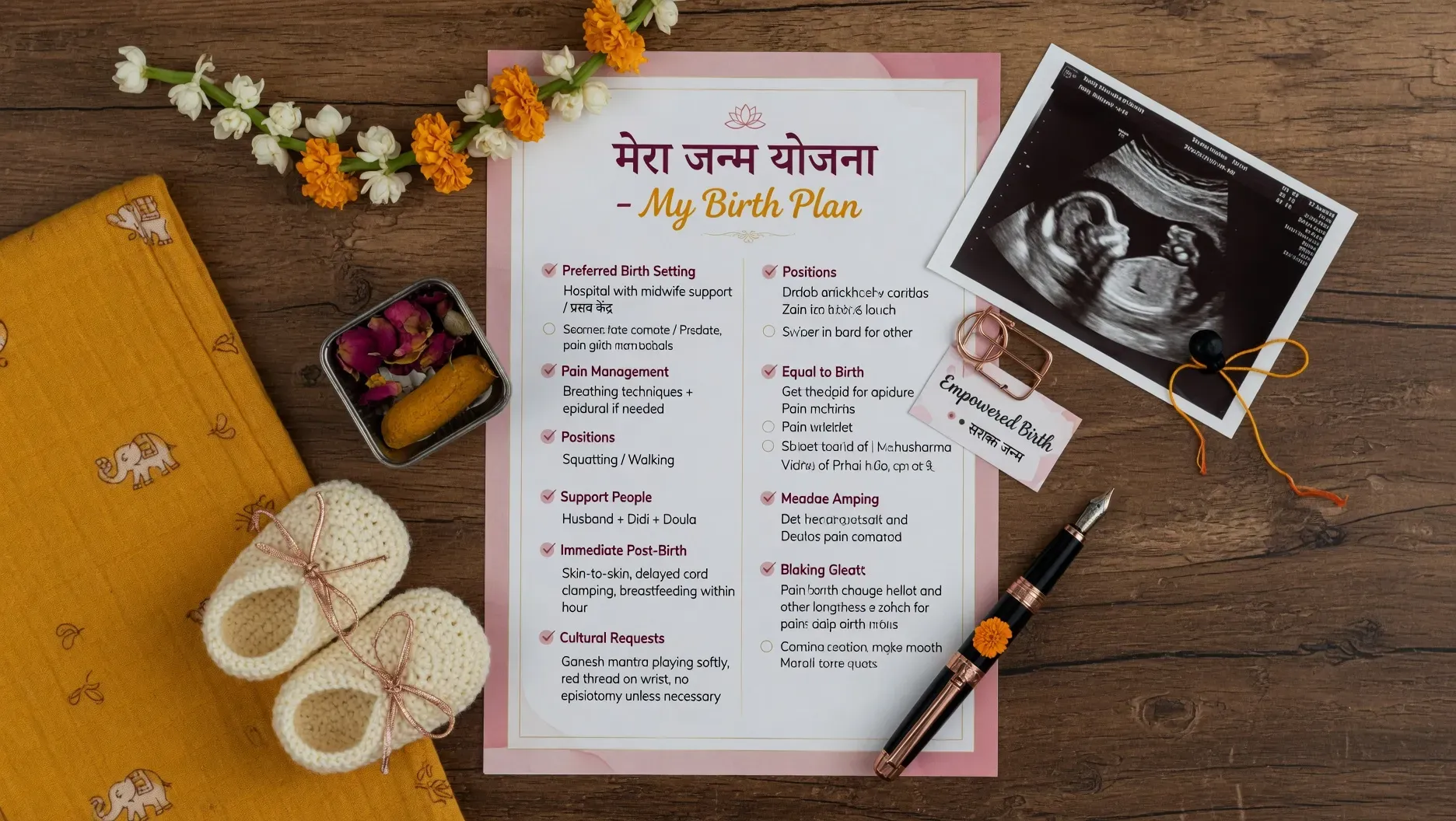
A birth plan is a written document that communicates your preferences for your labour and birth to the healthcare team caring for you. It covers what you would like to happen, what you would prefer to avoid if possible, and what your priorities are when choices need to be made.
In India, birth plans are less standard than they are in some Western countries, and the response to them varies considerably between providers and facilities. Some obstetricians welcome them as useful communication tools. Others are less familiar with them or view them with scepticism. Understanding this context — and knowing how to write and present a birth plan in a way that is most likely to be useful in an Indian hospital setting — determines whether it is a practical tool or a source of frustration.
What a birth plan is — and is not
A birth plan is not a contract. It is not a demand list. It is not a document that binds your care team to specific actions regardless of clinical circumstances.
Labour is unpredictable. The plan that makes perfect sense at 36 weeks may need to be entirely set aside at 8cm if circumstances require it. The value of a birth plan is not in its rigid execution — it is in the conversations it prompts beforehand, the clarity it gives you about your own priorities, and the communication shortcut it provides when you are in active labour and not in the best position to articulate complex preferences verbally.
A good birth plan communicates: here is what matters most to me, here are the things I would prefer if everything is going well, here is who I want present, here is how I want to be communicated with, and here is what I want to happen with the baby immediately after birth.
Why writing one helps even when it changes
The process of writing a birth plan is valuable independent of whether the plan is followed.
Thinking through what you actually want — not what you think you should want, not what your mother or mother-in-law wants, not what the hospital’s default protocol is — clarifies your priorities in a way that vague preferences do not. It prompts you to research your options, ask your doctor questions you might not otherwise think to ask, and arrive at the birth with a clearer sense of your own values around the experience.
It also creates a conversation with your partner. Going through the birth plan together means your partner knows what your preferences are, can advocate for them when you cannot speak for yourself, and understands your priorities rather than making assumptions in the moment.
What to include in a birth plan for an Indian hospital
Keep it brief — one page where possible. A long, detailed birth plan is less likely to be read thoroughly in a busy Indian hospital ward than a clear, concise one. Use short sections with bullet points.
Who will be present
- Who you want with you during labour (partner, your mother, a trusted family member)
- Whether you want family in the room during delivery or waiting outside
- Whether you want the room to be quiet or whether you want company and conversation
Movement and positioning during labour
- Whether you want to be able to move around during early labour rather than being confined to bed
- Positions you want to try — upright, on all fours, squatting
- Whether you want a birth ball available
Pain relief preferences
- What you know about the options available at your facility and what you want to know more about
- Whether you want to try without medication initially or whether you want early information about epidural availability
- Any preferences about non-pharmacological support — warmth, massage, breathing support
Monitoring and interventions
- Whether you would prefer intermittent monitoring if your labour is progressing normally, or whether continuous monitoring is fine
- Preferences around amniotomy (artificial rupture of membranes) — whether you want this delayed if labour is progressing
- Preferences around episiotomy — whether you want it avoided if possible or performed at the doctor’s discretion
Third stage and immediate post-birth
- Delayed cord clamping — whether you would like the cord to be allowed to stop pulsating before it is cut (typically 1–3 minutes)
- Who will cut the cord if this is something your partner wants to do
- Skin-to-skin contact immediately after birth — whether you want the baby placed on your chest before any assessments if the baby is well
- Breastfeeding — whether you want help initiating breastfeeding immediately after birth
If circumstances require a C-section
- Whether you want to be informed of what is happening as it happens
- Whether you want your partner present
- Whether you still want skin-to-skin as soon as possible if the baby is well
How to present it
Bring it to your 36-week appointment and discuss it with your doctor. “I have written down some preferences for the birth — can we go through them together and you can tell me what is realistic at this facility?” This approach is collaborative rather than confrontational.
Bring a copy to the hospital when you go into labour. Introduce it to the midwife or nursing staff who receive you: “I have some birth preferences written down — is it okay if I leave this with you so the team knows what I would like?”
Be prepared for some of your preferences not to be accommodated. In many Indian government hospitals and some private hospitals, the standard protocol differs from individual preferences, and the nursing staff are managing multiple patients simultaneously. The birth plan is most useful as a reference point and conversation starter, not as a rigid set of demands.
Holding your plan lightly
The most important thing about a birth plan is knowing when to let it go.
Labour is not predictable, and the circumstances that matter most are clinical ones that override any preference you have written down. If the baby needs to be born immediately, the preferences about who cuts the cord are irrelevant. If an epidural is what allows you to continue rather than exhausting yourself to the point of crisis, the preference for a medication-free birth is secondary to your wellbeing.
Write the plan. Know what matters to you. Communicate it to the people who need to know it. And then hold it lightly — the goal is a safe birth, and the plan is a guide toward that rather than a contract for it.
This article is for general educational purposes only. Discuss your birth preferences with your doctor and care team well in advance of your due date.