
Pain Relief Options During Labour in Indian Hospitals: What Is Available and What to Ask
A practical guide to labour pain relief options available in Indian hospitals — epidurals, entonox, opioid medications, non-pharmacological options, and how to ask your provider what is available at your specific facility.
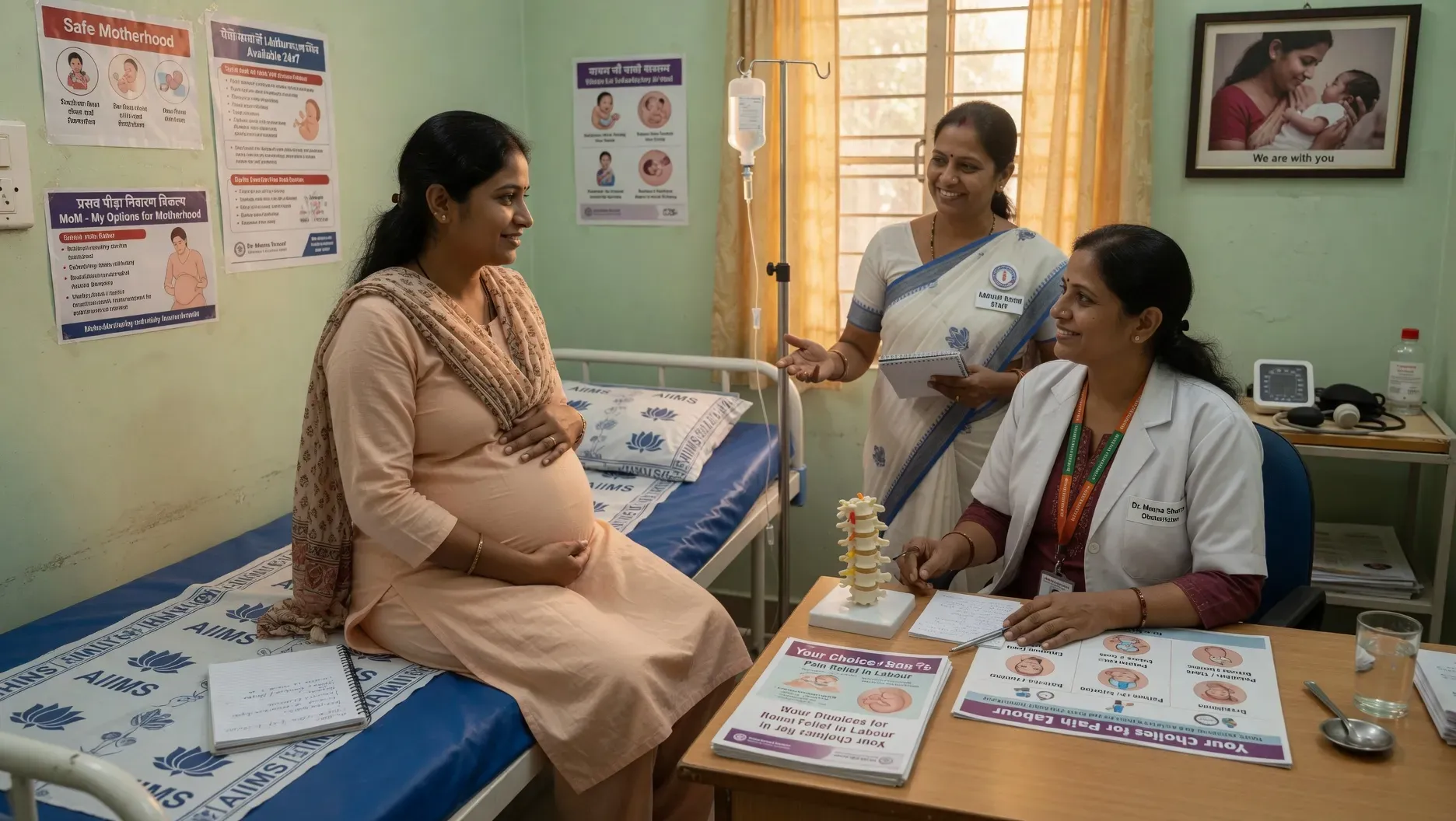
Labour pain is one of the most intense physical experiences the human body produces — and the options for managing it in Indian hospitals are more varied than many women know, but less uniformly available than guidance written for other healthcare contexts might suggest.
This guide covers what options exist, what each involves, and — critically — how to find out what is actually available at the specific facility where you will give birth, since availability varies significantly between hospitals, between cities, and between government and private facilities.
The non-pharmacological options (available everywhere)
These options are available regardless of the facility and do not require special equipment or anesthesiologist presence:
Movement and positioning. Upright positions — walking, standing, rocking, sitting on a birth ball — use gravity to aid the baby’s descent and have been consistently shown to reduce pain perception and shorten labour duration. Changing positions frequently in early labour is one of the most effective and most underutilised pain management strategies. Being confined to bed continuously is not medically required during uncomplicated labour.
Warm water. A warm shower or bath (where available) provides significant pain relief during active labour. Warm water on the lower back during contractions is particularly effective for back labour.
Breathing and relaxation techniques. Slow, rhythmic breathing during contractions — focusing on the out-breath and allowing the body to relax between contractions — reduces pain perception and, more importantly, prevents the panic response that amplifies pain. These techniques are most effective when practised before labour rather than learned during it. Antenatal preparation classes or prenatal yoga that specifically addresses breathing for labour is worthwhile.
Massage and counter-pressure. Firm counter-pressure on the lower back during contractions — applied by a partner or support person, using the heel of the hand — provides significant relief for back labour. Massage of the lower back, hips, and shoulders between contractions reduces muscle tension.
Presence of a support person. Research consistently shows that continuous support during labour — from a partner, family member, or doula — reduces pain perception, reduces the use of pharmacological pain relief, and improves birth outcomes. This is not a soft finding — it is one of the most robustly demonstrated interventions in labour care.
Mental focus and distraction. Some women find that focusing on a specific point, counting breaths, or using guided visualisation provides a layer of mental management over the physical intensity.
Entonox (laughing gas)
Nitrous oxide (Entonox or laughing gas) is inhaled through a mask held by the woman and takes effect within seconds. It does not eliminate pain but alters the perception of it, producing a slight dissociation that many women find makes contractions more manageable.
Availability in India: More widely available in private hospitals and some tertiary government hospitals than was previously the case, but not universally so. Worth asking about specifically at your pre-admission visits.
Characteristics: It is self-administered — you hold the mask and inhale at the beginning of each contraction. The effect is rapid and wears off quickly between contractions. It is safe for the baby. Common side effects include lightheadedness and nausea.
Opioid pain medications (pethidine / morphine)
Opioid injections — most commonly pethidine (meperidine) or morphine — are available at most Indian hospitals, both government and private.
How they work: Injected intramuscularly, they provide systemic pain relief — reducing the intensity of contraction pain without eliminating it. They also have a sedative effect that some women find helpful for rest between contractions.
Limitations: They do not provide the level of pain relief that an epidural provides. They cross the placenta and can affect the baby — if given too close to the birth, they can cause respiratory depression in the newborn, which is why timing matters and why the baby is monitored after administration. Many women find the sedative effect disorienting.
Availability: Widely available. If you want opioid pain medication during labour, it is likely to be accessible at any hospital.
Epidural analgesia
An epidural is the most effective pharmacological pain relief available during labour. A catheter is inserted into the epidural space in the lower back by an anesthesiologist, through which a local anaesthetic is delivered. When effective, it eliminates or nearly eliminates contraction pain while allowing the woman to remain awake and, in modern low-dose epidurals, to retain some sensation in the legs.
Why epidurals matter for Indian women to understand: The epidural is the most effective pain relief available and is routinely used in labour in many countries. In India, access is significantly uneven.
Availability: Widely available at most private hospitals and tertiary government hospitals in major cities. Less available at smaller private hospitals, district government hospitals, and in smaller cities and towns. Availability depends on 24-hour anesthesiologist cover — facilities that do not have an anesthesiologist available around the clock cannot offer an epidural safely at any hour.
What to ask your hospital before your due date: “Do you provide epidural analgesia during labour? Is it available 24 hours a day? What are the criteria for accessing it?” This is one of the most important questions to ask at your pre-delivery hospital visit.
Epidural characteristics: Takes approximately 15–20 minutes to set up and take effect. Does not increase the risk of C-section, though it may slow the second stage slightly. Is not associated with long-term back pain, despite this being a widespread belief. Can be topped up for a C-section if one becomes necessary. The most common side effects are a drop in blood pressure (monitored and managed) and, in low-dose epidurals, the inability to feel the urge to push as clearly as without one.
Asking about pain relief before your due date
The most important thing you can do regarding labour pain relief is to have this conversation with your doctor and your hospital before you are in active labour. Specific questions:
- What pain relief options are available at this facility?
- Is epidural available 24 hours a day, including at night and on weekends?
- What are the criteria for an epidural — is it available on request or only under certain conditions?
- Is there an anesthesiologist available at this facility around the clock?
- What are the opioid options and when are they given?
- Is entonox available?
- What is your (doctor’s) approach to labour pain relief?
The last question is particularly relevant because Indian obstetric practice varies considerably in its approach to labour analgesia. Some obstetricians actively support whatever pain relief the woman wants; others are less supportive of epidurals for non-medical reasons. Knowing your doctor’s position — and whether it aligns with yours — before you are in labour is important.
This article is for general educational purposes only. Pain relief availability and protocols vary significantly between hospitals. Discuss your options specifically with your care team at the facility where you plan to deliver.