
Naming Your Baby: Kerala and Indian Naming Traditions and How Families Navigate Them
A warm guide to Kerala and Indian baby naming traditions — Naamakaranam, nakshatra names, family customs, and how modern families find a name that works for everyone.
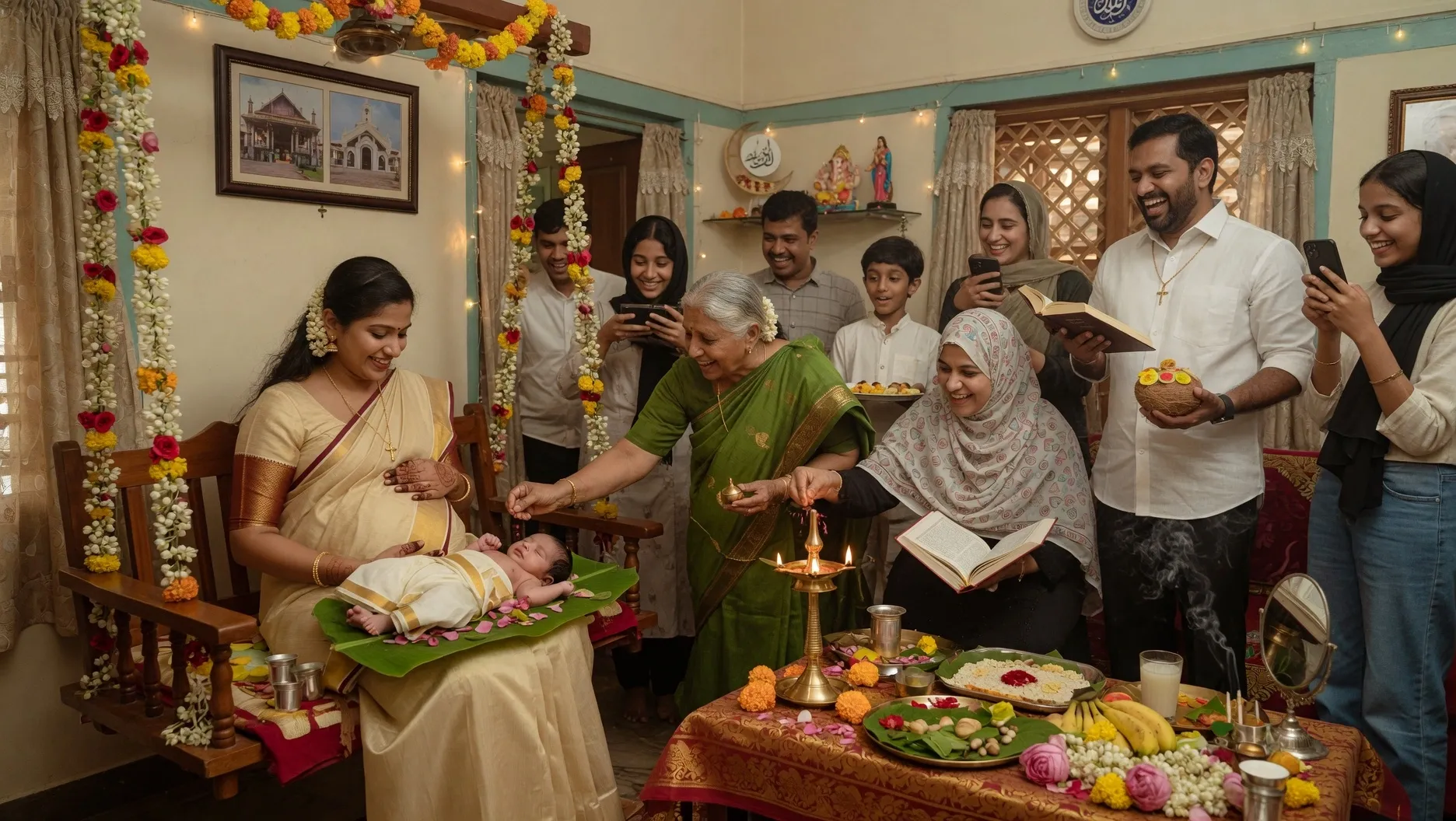
Choosing a name for your baby is one of the first significant decisions you will make as a parent. In Kerala and across India, it is also rarely a decision that belongs only to the parents.
Names in Indian culture carry weight that goes beyond personal preference. They carry family lineage, religious meaning, astrological significance, the hopes of grandparents, the memory of ancestors, and occasionally the strong opinions of every adult in a joint family who believes they have a stake in what the new child will be called for the rest of their life.
This guide is for parents who want to understand the traditions around baby naming in Kerala and India — what they mean, where they come from, and how to navigate the process in a way that honours the family while still ending up with a name you actually love.
The Naamakaranam ceremony
In the Hindu tradition, the formal naming of a baby is done through a ceremony called Naamakaranam — one of the sixteen Samskaras that mark significant life stages. Naamakaranam is traditionally performed on the eleventh or twelfth day after birth, though many families observe it in the first month or at a time chosen in consultation with a priest or astrologer.
The ceremony involves:
- The naming itself, announced formally in a ritual context
- Mantras recited by a priest, welcoming the child and offering prayers for their life
- Whispering the name into the child’s ear — traditionally by the father or a senior family member — so the baby hears their name for the first time in the presence of family and blessings
- A gathering of family and community to witness and celebrate
In Kerala, the Naamakaranam is sometimes combined with the baby’s first outing (Nishkramana), the first feeding of solid food (Annaprasana), or other early life ceremonies, depending on family tradition.
Christian families in Kerala typically name babies at baptism, which may occur within the first few weeks of life. The ceremony includes the formal announcement and blessing of the name in a church setting. Muslim families follow Islamic naming traditions, which include the Aqiqah ceremony and the Adhan whispered into the newborn’s ear at birth.
How names are traditionally chosen in Kerala
The process of choosing a name in Hindu Kerala families often begins before the birth — sometimes before the pregnancy — through a combination of:
Nakshatra (birth star) naming
In the Hindu astrological system, each baby is born under a specific nakshatra — one of 27 lunar mansions — determined by the position of the moon at the time of birth. Each nakshatra is associated with specific syllables, and traditional naming practice begins the baby’s name with the syllable associated with their birth star. A child born under Rohini nakshatra, for example, might be given a name beginning with O, Va, Vi, or Vu depending on the specific pada (quarter) of that nakshatra.
For many Kerala families, this is the first filter in name selection — the nakshatra syllable narrows the options before personal preference applies.
Family and lineage names
In Kerala, particularly in traditional Hindu families, the family name (tharavad name) or a variation of an ancestor’s name is often incorporated into or considered for the baby’s name. Naming a child after a grandparent — particularly a recently deceased one — is common and carries the sense of continuing the family lineage.
Deity names and religious names
Names connected to Hindu deities, their attributes, or their stories are among the most common in Kerala — Krishnan, Devika, Lakshmi, Vishnu, Uma, Rama and their many variations. In Christian Kerala families, biblical names and the names of saints are traditional. In Muslim families, names with Arabic Islamic roots are standard practice.
Meaning and auspiciousness
In the classical naming tradition, a name should have a good meaning and be auspicious — it should not carry the name of something inauspicious or the name of an enemy. Modern families often retain this principle while applying it through a more contemporary lens — choosing names with positive meanings in Sanskrit, Malayalam, or both.
The family negotiation
Here is the reality that most naming guides skip over: in a Kerala joint family context, choosing a baby’s name is rarely as simple as two parents making a private decision.
Grandparents often have strong opinions and sometimes expectations — particularly about the use of family names or names connected to the lineage. The paternal and maternal sides of the family may have different traditions and different candidates. A priest or astrologer consulted for the nakshatra name may suggest names that the parents don’t particularly love. And the parents themselves may disagree.
This is normal. It is also genuinely stressful during the exhausted early weeks of new parenthood.
A few things that can help navigate this:
Start the conversation before the birth. Discussing naming preferences — including how much weight to give to nakshatra naming, family names, and grandparents’ suggestions — before the baby arrives gives everyone more time and less urgency. Decisions made in the calm of the third trimester tend to go better than decisions made under the pressure of the naming ceremony.
Be clear about what matters to you. If the nakshatra syllable is important to your family but the specific name is yours to choose, saying that clearly — early — helps manage expectations. If you want a name that works in both Malayalam and in a professional context outside Kerala, that’s a legitimate preference worth stating.
Give grandparents a role. Even if the final name is not the one they suggested, finding a way to involve grandparents in the process — asking for their suggestions, explaining the choice, perhaps using a family name as a middle name — often matters more than the specific outcome.
You are the parents. This is worth saying clearly, even in a culture that values family input and collective decision-making. Grandparents, aunts, uncles, and family priests can all have input. The decision belongs to you. A name that will be used every day for a lifetime is yours to choose.
Modern Kerala naming
Naming patterns in Kerala have shifted noticeably across generations. Grandparents are more likely to have single Kerala names — Thankamma, Kunjamma, Rajan, Govindan — that are clearly rooted in Malayalam and in the village culture of their generation. Parents in their thirties and forties today are more likely to have names that work in both Kerala and in a professional or educational context outside it — Ananya, Arjun, Divya, Arun. And parents choosing names for babies in 2026 are often thinking about names that carry cultural meaning but are also legible internationally.
This is not a loss of tradition. It is what tradition does — it adapts to the world the next generation will actually live in.
A note on spelling and pronunciation
One practical consideration that modern Kerala parents increasingly think about: how the name will be spelled and pronounced outside Kerala. A name that is clear and beautiful in Malayalam may be consistently mispronounced or misspelled in Hindi, English, or Gulf Arabic contexts — all of which many Kerala families navigate regularly.
This is not a reason to choose a less meaningful name. But it is a real practical consideration, and thinking through how the name will function in all the contexts your child will inhabit is part of choosing thoughtfully.
This article is for cultural and general informational purposes. Naming traditions vary widely between communities, religions, and families across Kerala and India.