
Gestational Diabetes and Indian Food: How to Manage Blood Sugar With Familiar Meals
A practical guide to managing gestational diabetes with Indian and Kerala cooking — without giving up the foods you love.
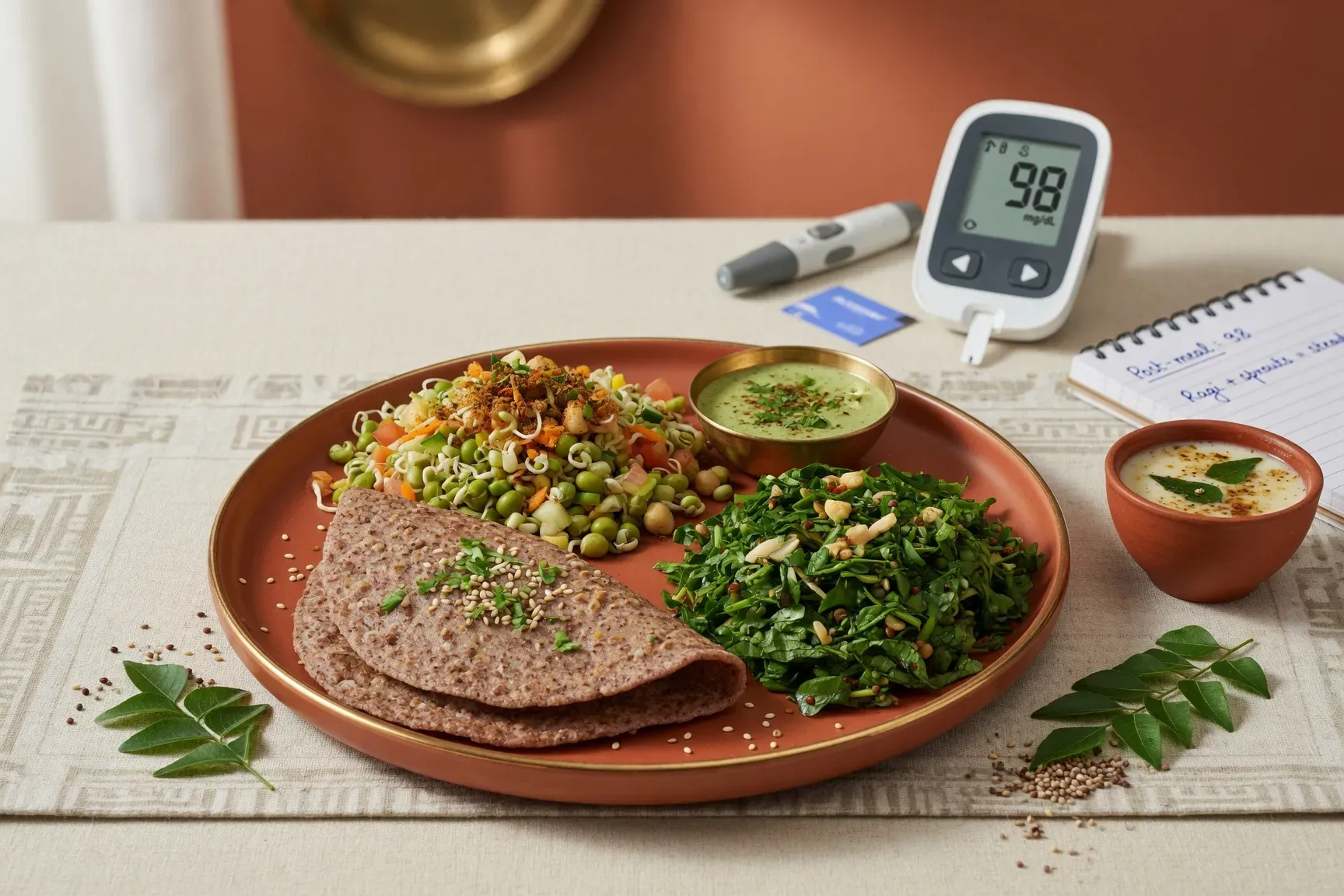
A gestational diabetes diagnosis can feel, in the moment, like being told that everything you normally eat is now a problem.
The foods that form the basis of South Indian and Kerala cooking — rice, roti, dosa, idli, sweet fruit, banana — are carbohydrate-rich foods, and gestational diabetes is a condition about how your body manages carbohydrates. So it’s understandable that the diagnosis can feel like it has put your entire food culture on a list of things to avoid.
The reality is considerably more manageable than that first anxious reading of the situation suggests. Gestational diabetes does not require you to stop eating Indian food. It requires you to understand which aspects of how you eat are affecting your blood sugar, and to make some specific adjustments — some of which are smaller than you might expect — that bring your levels into a better range.
This article is about how to do that practically, with the ingredients and cooking methods you already know.
What gestational diabetes actually is
Gestational diabetes occurs when pregnancy hormones — particularly from the placenta — interfere with insulin function, making it harder for your body to process glucose effectively. Blood glucose rises higher than it should after meals and takes longer to return to baseline. This is distinct from Type 1 or Type 2 diabetes, and in most cases it resolves after birth — though it does increase the long-term risk of Type 2 diabetes, which is worth knowing.
During pregnancy, elevated blood glucose creates real risks: a larger baby (macrosomia), which increases delivery complications; a higher risk of preterm birth; and for the baby after birth, an increased risk of low blood sugar, breathing difficulties, and later obesity and Type 2 diabetes. For you, it increases the risk of preeclampsia and of a difficult birth.
These risks are why managing blood sugar during pregnancy matters. And the good news is that for most women with gestational diabetes, dietary management — combined with monitoring and sometimes medication — is effective.
The basics of blood sugar management through food
Before getting to specific Indian foods, it helps to understand the three principles that underpin blood sugar management through diet:
Carbohydrates raise blood glucose — specifically, refined and high-glycaemic carbohydrates raise it quickly and significantly. Whole grain and high-fibre carbohydrates raise it more slowly and to a lower peak. The amount and type of carbohydrate in a meal are both relevant.
Protein and fat slow glucose absorption — eating carbohydrates alongside protein and healthy fat reduces the rate at which glucose enters the bloodstream, resulting in a flatter, more manageable rise. This is why eating rice alongside dal and a vegetable is different, metabolically, from eating rice alone.
Meal timing and portion size matter — large amounts of carbohydrate in one sitting cause larger glucose spikes than smaller amounts spread across the day. Smaller, more frequent meals are usually recommended in gestational diabetes management.
These principles are the same for everyone managing blood sugar through food, but they intersect with Indian eating patterns in specific ways.
The Indian foods that cause the most significant blood sugar spikes
Understanding which foods spike blood sugar helps you make targeted changes rather than overhauling everything at once.
White rice in large portions — rice is the food that comes up most in this context, because it is the staple carbohydrate in most South Indian and Kerala meals, it has a relatively high glycaemic index, and it is often eaten in substantial quantities. This doesn’t mean rice is off limits, but portion size and what it’s eaten with matter a great deal.
Refined flour (maida) — parotta, white bread, and highly processed breads and snacks made with maida cause significant glucose spikes. These are worth reducing more significantly than whole grains.
Soft-cooked or overcooked rice and starchy foods — the longer rice or other starches are cooked, the higher their glycaemic index becomes. Slightly firmer rice raises blood sugar more slowly than very soft, overcooked rice.
Sugary drinks and fruit juices — tender coconut water, fruit juices, and sweetened chai are absorbed quickly and raise blood glucose fast. Whole fruit, eaten rather than juiced, has a meaningfully lower glycaemic impact.
Banana, mango, and sapota (chikoo) in large amounts — these are higher-sugar fruits that are worth moderating during gestational diabetes management. Smaller portions and pairing them with protein helps.
Jaggery, honey, and sugar — all forms of added sugar have similar effects on blood glucose in the amounts typically consumed, despite the perception that jaggery is “healthier” than refined sugar. In gestational diabetes, all should be moderated.
The Indian foods that support blood sugar management
Now the more useful list — the foods from an Indian kitchen that naturally support more stable blood glucose:
Lentils and legumes — dal, rajma, chana, moong, and all other lentils and legumes have a low glycaemic index, provide protein and fibre that slow glucose absorption, and should be the cornerstone of a gestational diabetes diet. Eating dal with every meal rather than rice alone is one of the most practical interventions available.
Non-starchy vegetables — most vegetables eaten in South Indian cooking — drumstick, raw banana (cooked), cabbage, beans, bitter gourd, ash gourd, ladies finger, leafy greens — have minimal effect on blood glucose and can be eaten freely. Vegetable-based preparations like thorans, stir-fries, and koottukari are excellent choices.
Ragi (finger millet) — has a significantly lower glycaemic index than white rice or refined wheat flour, and is high in fibre. Ragi porridge, ragi dosa, and ragi roti are all meaningful upgrades from their white-rice or maida equivalents.
Bitter gourd (pavakka / karela) — has traditional use and some evidence for supporting blood glucose regulation. Including it regularly is both nutritionally useful and consistent with how it’s already used in Kerala cooking.
Whole grains — brown rice, whole wheat atta, red rice, matta rice — all have a lower glycaemic index than white rice and can often be substituted without fundamentally changing a dish.
Eggs, fish, chicken, paneer, tofu — protein sources that pair with carbohydrates to slow glucose absorption. Ensuring every meal contains a good protein source is one of the most practical strategies for managing postmeal blood sugar spikes.
Curd and buttermilk — low glycaemic, provide protein and probiotics, and can be used to accompany or finish meals in ways that moderate the overall glycaemic impact.
Nuts and seeds — almonds, walnuts, pumpkin seeds, and sesame seeds have minimal glycaemic impact and provide fat and protein. Useful as snacks when something is needed between meals.
Practical adjustments to familiar South Indian meals
Rather than telling you what to eat instead, here is how existing meals can be adjusted:
Rice and dal — reduce the portion of rice, increase the portion of dal, add a vegetable thoran. Serve rice that is slightly firmer rather than very soft. Eat dal and vegetables first, then the rice — this reduces the immediate glycaemic impact of the meal as a whole.
Dosa and idli — these are fermented, which slightly lowers their glycaemic index compared to non-fermented preparations. Ragi dosa is a lower-glycaemic alternative. Pair with a protein-rich sambar and coconut chutney rather than sweet accompaniments. Be mindful of how many you eat in one sitting.
Biriyani and rice dishes — these tend to be high in rice volume. A smaller portion alongside a protein-rich accompaniment, and eaten with raita, is more manageable than a large helping of rice-forward biriyani.
Chai — reduce or eliminate sugar. Many women find they adjust to less sweet chai within a few days. If nausea is making chai important for comfort, a very small amount of sugar is better than eliminating it entirely and struggling.
Snacks — swap sweet snacks, banana chips, and biscuits for a handful of nuts, a boiled egg, a small piece of paneer, buttermilk, or a small amount of ragi laddoo (made with minimal jaggery).
Fruit — continue eating fruit, but as a whole fruit rather than juice, in smaller portions, and paired with a protein source where possible.
Eating patterns matter as much as food choices
Gestational diabetes management isn’t only about which foods you eat — it’s also about when and how much.
Smaller, more frequent meals work better than three large ones. Aim for three moderate meals and two to three small snacks throughout the day, rather than leaving long gaps or eating large amounts in one sitting.
Don’t skip meals — particularly breakfast. Fasting overnight leads to a different glucose pattern, and skipping breakfast can lead to compensatory overeating later in the day that causes larger spikes.
Walk after meals — even ten to fifteen minutes of walking after a meal improves glucose uptake and meaningfully reduces postmeal blood sugar levels. This is one of the simplest and most evidence-supported interventions available, and it costs nothing.
Monitor as your provider advises — blood glucose monitoring tells you how your specific body responds to specific foods, which is more useful than general guidance. Some women spike significantly after matta rice; others tolerate it well. The monitor gives you data that general advice cannot.
What your care team will tell you that this article cannot
Gestational diabetes management is specific to your numbers, your pregnancy, your body’s insulin response, and your provider’s guidance. Some women manage well through diet and exercise alone. Others need medication alongside dietary changes. Your care team’s specific recommendations — from your obstetrician, from a diabetes specialist, and ideally from a registered dietitian familiar with Indian food patterns — are what should guide your actual plan.
This article is orientation, not a prescription. It is meant to reassure you that managing gestational diabetes does not require abandoning South Indian food, and to give you a starting framework for understanding which adjustments are likely to matter most.
The goal is not a restrictive diet that makes you miserable. It is a pattern of eating that keeps your blood glucose in a range that protects both you and your baby — and that you can sustain across the remaining weeks of your pregnancy. That is achievable with the food you know. It just requires a little more attention than you may have been paying before.
This article is for general educational purposes only and does not replace personalised nutrition or medical advice. Always consult your doctor, midwife, or a registered dietitian for personalised guidance on managing gestational diabetes.