Back Pain During Pregnancy: Exercises and Stretches That Actually Help
A practical guide to managing back pain during pregnancy — why it happens, which exercises and stretches provide real relief, and what movements to avoid.
Back pain is one of the most common complaints of pregnancy — affecting up to 70% of pregnant women at some point, and for many becoming a persistent feature of the second and third trimesters. Understanding why it happens and what specifically helps makes a meaningful difference to how manageable it is.
Why back pain happens during pregnancy
Several factors converge:
The growing uterus shifts your centre of gravity forward. To compensate, the lumbar spine curves more deeply inward (increased lordosis), placing increased load on the muscles and joints of the lower back.
Relaxin loosens ligaments throughout the body. This is essential for the pelvis to accommodate birth, but it means the stabilising structures of the spine and pelvis are less taut, placing more demand on the muscles to provide stability.
The abdominal muscles stretch and weaken. The deep core muscles that normally support the spine are stretched and compromised by the growing uterus, reducing their ability to offload the back.
The additional weight. The total weight of the growing baby, placenta, amniotic fluid, and increased blood volume adds load to every structure that supports the spine.
Posture changes at work and rest. Sitting for extended periods, sleeping on a couch that doesn’t support the spine, carrying older children, standing in ways that increase the forward pelvic tilt — all compound the structural changes of pregnancy.
Exercises that help
Pelvic tilts
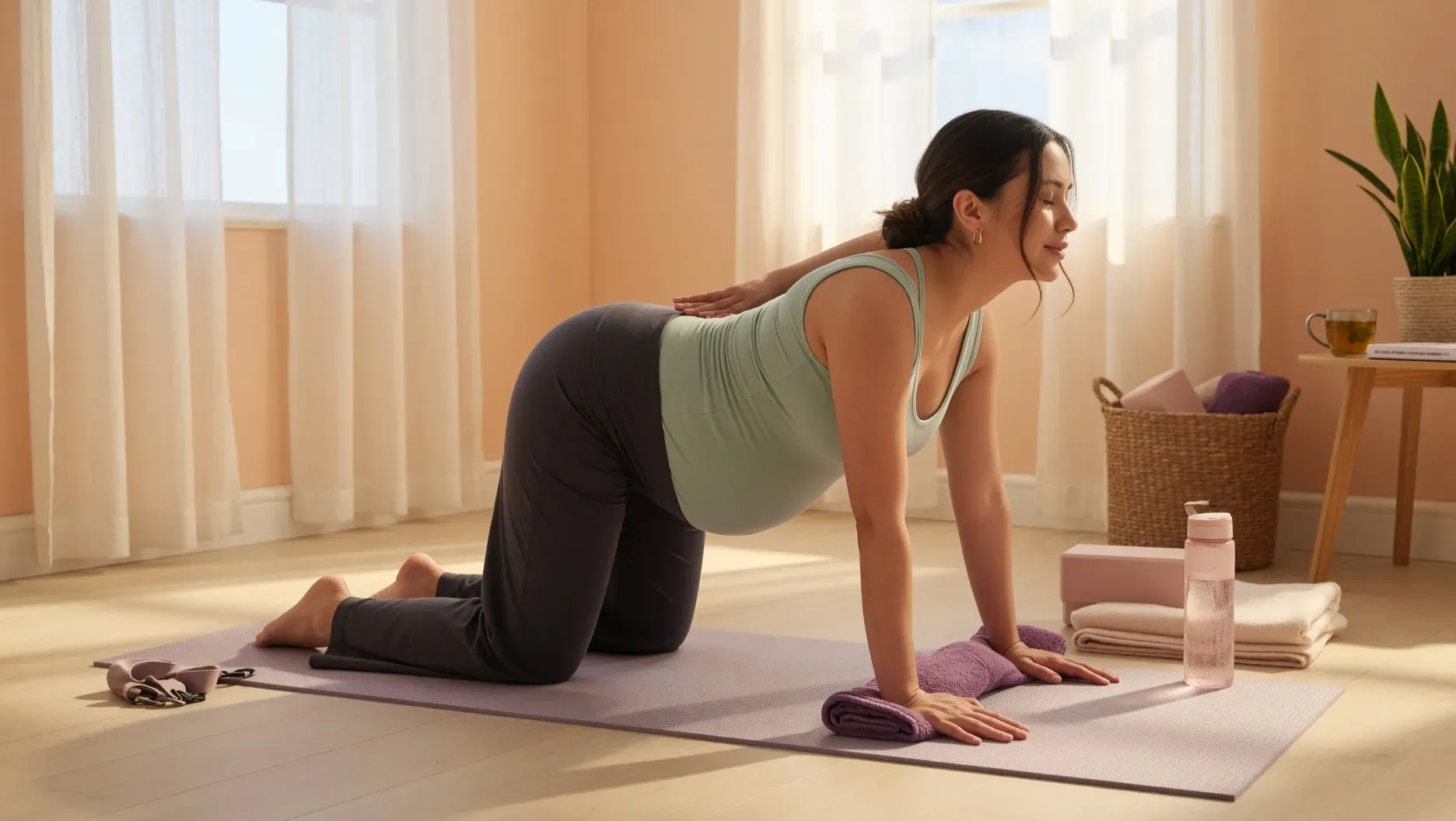
The most consistently recommended exercise for pregnancy back pain. Lie on your back with knees bent and feet flat (safe in the first and second trimesters; modify by doing this on hands and knees in the third trimester). Gently flatten your lower back against the floor by tightening your abdominals and tilting the pelvis. Hold for a few seconds, release. Repeat 10–15 times.
On hands and knees, this becomes the cat-cow movement — arching the back upward (cat) and then letting it drop toward the floor (cow). This is comfortable throughout all trimesters and specifically mobilises the lumbar spine.
Swimming and water exercise
As discussed in a separate guide, water provides buoyancy that directly relieves the load on the lower back. The back pain relief from swimming is often the most immediate and complete of any pregnancy exercise option.
Walking
Regular gentle walking maintains the muscle condition of the legs, glutes, and core that support the spine, without the impact of higher-intensity exercise. Keep posture in mind while walking — avoid the pregnancy waddle, which exaggerates lumbar lordosis and increases back load.
Prenatal yoga
Specifically the poses designed for the lower back and pelvis: child’s pose (modified with knees wide to accommodate the bump), low lunge, supported warrior poses, pigeon pose (modified), and gentle seated forward folds. Prenatal yoga classes taught by instructors experienced with pregnancy modifications are the safest way to access these benefits.
Stretches that provide specific relief
Child’s pose (modified)
Kneel on the floor, open knees wider than hip-width to accommodate the bump, lower your upper body toward the floor with arms extended. This stretches the lower back, hips, and glutes and provides immediate relief for many women. Hold for 30–60 seconds.
Hip flexor stretch (low lunge)
From standing, step one foot forward into a lunge position, lowering the back knee to the floor. Gently shift your hips forward to feel the stretch in the front of the hip and thigh of the back leg. Hip flexors that are shortened from sitting become a significant contributor to lower back pain — this stretch addresses that directly.
Piriformis stretch
Sitting on a chair, cross one ankle over the opposite knee, gently press down on the crossed knee, and lean slightly forward. This stretches the piriformis muscle in the buttock, which when tight can refer pain into the lower back and down the leg (similar to sciatica).
Thread the needle
On hands and knees, slide one arm along the floor beneath the opposite arm and shoulder, rotating the upper body. This releases thoracic (mid-back) tension that often compounds lumbar discomfort.
Side-lying hip and back release
Lying on your side with a pillow between your knees, draw the top knee toward your chest and hold for 30 seconds. This releases the lower back and hip simultaneously.
What to avoid
- Exercises that involve lying flat on the back for extended periods in the second and third trimesters
- High-impact exercises that jar the spine
- Exercises involving twisting of the torso, particularly in the third trimester
- Carrying heavy loads or lifting from a bent-back position
- Maintaining any position — sitting or standing — for extended periods without movement
When back pain needs medical evaluation
Most pregnancy back pain is musculoskeletal and responds to the exercises and stretches described above. Seek medical attention for:
- Back pain that is severe, constant, or worsening rather than episodic
- Pain that radiates down one leg, particularly if accompanied by numbness or tingling (possible sciatica or disc involvement)
- Back pain accompanied by urinary or bowel changes (rare but serious)
- Back pain in the context of other concerning symptoms — fever, bleeding, contractions
A physiotherapist — particularly one with experience in pregnancy — can provide specific assessment and targeted exercises for your individual pattern of back pain and is a worthwhile referral if pain is significantly affecting your daily function.
This article is for general educational purposes only. If back pain is severe, persistent, or accompanied by other symptoms, consult your doctor or a qualified physiotherapist.