Anaemia During Pregnancy: Why It Is So Common in India and What to Do About It
Why anaemia affects more than half of pregnant Indian women, what the consequences are, and what actually helps — through food, absorption, and supplementation.
More than half of pregnant women in India are anaemic. That number is not a footnote. It is the central fact around which this article is built — because it means that if you are pregnant in India, anaemia is not a remote possibility. It is something that either already affects you or requires active attention to prevent.
Anaemia in pregnancy is not a minor inconvenience. At its moderate and severe end, it is a condition with real consequences: for how you feel throughout pregnancy, for your experience of labour, for your recovery afterward, and for your baby’s health both at birth and into early childhood. It is also, in most cases, a manageable condition. The challenge in India is not that anaemia cannot be treated — it is that it is enormously undertreated, underdiagnosed, and underestimated.
This article is about understanding what anaemia in pregnancy actually is, why it is so common in the Indian context specifically, and what the combination of food, absorption strategies, and supplementation can do about it.
What anaemia is and why pregnancy makes it worse
Anaemia occurs when the blood contains too few healthy red blood cells, or when those cells contain insufficient haemoglobin — the iron-containing protein that carries oxygen to every tissue in the body.
During pregnancy, blood volume expands by forty to fifty percent. The body needs substantially more red blood cells to fill this expanded volume, which means it needs substantially more iron. If iron supply — from diet, from absorption, or from pre-existing stores — cannot keep pace with this demand, haemoglobin levels fall and anaemia develops.
Iron deficiency is the most common cause of anaemia in pregnancy in India, accounting for the vast majority of cases. But folate deficiency and vitamin B12 deficiency can also cause anaemia, and in some cases more than one deficiency is present simultaneously. This is why blood tests — rather than symptoms alone — are the appropriate way to confirm what type of anaemia is present and how severe it is.
The diagnostic threshold used during pregnancy is a haemoglobin level below 11 g/dL in the first and third trimesters, and below 10.5 g/dL in the second trimester. Mild anaemia is 10–10.9 g/dL. Moderate anaemia is 7–9.9 g/dL. Severe anaemia — below 7 g/dL — is a medical emergency in pregnancy.
Why anaemia is so prevalent in India
Several factors converge to make India one of the highest-burden countries for pregnancy anaemia globally:
Pre-existing iron deficiency before pregnancy begins — many Indian women enter pregnancy already iron-depleted, because menstrual blood loss has not been offset by adequate dietary intake over the years preceding pregnancy. Pregnancy then imposes an additional iron demand on already low stores.
A predominantly plant-based diet with lower bioavailability iron — the majority of iron in a traditional Indian diet is non-haem iron from lentils, vegetables, and grains. Non-haem iron is absorbed at two to twenty percent efficiency, compared to fifteen to thirty-five percent for haem iron from animal sources. The diet is iron-containing — but much of that iron is not being absorbed.
High phytate intake — rice, wheat, and legumes all contain phytic acid, which binds to iron and zinc in the digestive tract and reduces their absorption. The South Indian diet, which is high in these foods, can significantly impair iron bioavailability despite reasonable dietary iron content.
Tea consumed with meals — chai is embedded in the daily rhythm of most Indian households, and the tannins in tea are among the most potent inhibitors of iron absorption available in the diet. Drinking tea around mealtimes — which is the norm rather than the exception — meaningfully reduces how much iron is absorbed from food.
Frequent pregnancies in close succession — when pregnancies are closely spaced, the body does not have adequate time to rebuild iron stores between them. Each subsequent pregnancy begins from a lower iron baseline.
Inadequate or inconsistent supplementation — India’s national Anaemia Mukt Bharat programme provides iron and folic acid tablets through the antenatal care system, but uptake is inconsistent and side effects (constipation, nausea) lead many women to stop taking them.
Poor absorption due to gut health issues — intestinal infections and parasitic infestations, which remain common in some parts of India, impair nutrient absorption broadly and iron specifically.
The consequences that matter
Understanding consequences matters because it changes how seriously anaemia is taken — both by women experiencing it and by the family members whose support makes a difference to whether it gets addressed.
For you during pregnancy: Deep, persistent fatigue that rest does not resolve. Breathlessness doing ordinary activities. Dizziness. Rapid or irregular heartbeat. Headaches. Reduced immune function. Difficulty concentrating.
For labour and delivery: Women with significant anaemia are at much higher risk of complications if there is blood loss during or after delivery — which is one reason why anaemia is a direct contributor to maternal mortality in India.
For postpartum recovery: Anaemic women recover more slowly after birth, have more difficulty breastfeeding due to fatigue, and are more vulnerable to postpartum depression, which is itself associated with iron deficiency.
For your baby: Babies born to severely anaemic mothers have lower birth weights and are more likely to be born prematurely. They also enter the world with lower iron stores, because the baby depends on maternal iron for building their own reserves in the third trimester. Low neonatal iron stores mean faster progression to iron deficiency in infancy, which affects neurodevelopment.
How anaemia is detected
Routine haemoglobin testing at the first antenatal visit is the standard of care in India. Testing is typically repeated at approximately twenty-eight to thirty weeks and again near the end of pregnancy.
If your haemoglobin is low, your provider may also check serum ferritin (which reflects iron stores), serum folate, vitamin B12, and peripheral blood smear to understand the nature and cause of the anaemia. The type of anaemia determines the treatment — iron deficiency responds to iron supplementation; folate deficiency requires folate; B12 deficiency requires B12. Getting the type right is important.
What actually helps: food and absorption strategies
The iron-rich Indian foods and absorption strategies are covered in detail in the companion nutrition articles in this series. The most important practical points for women managing anaemia:
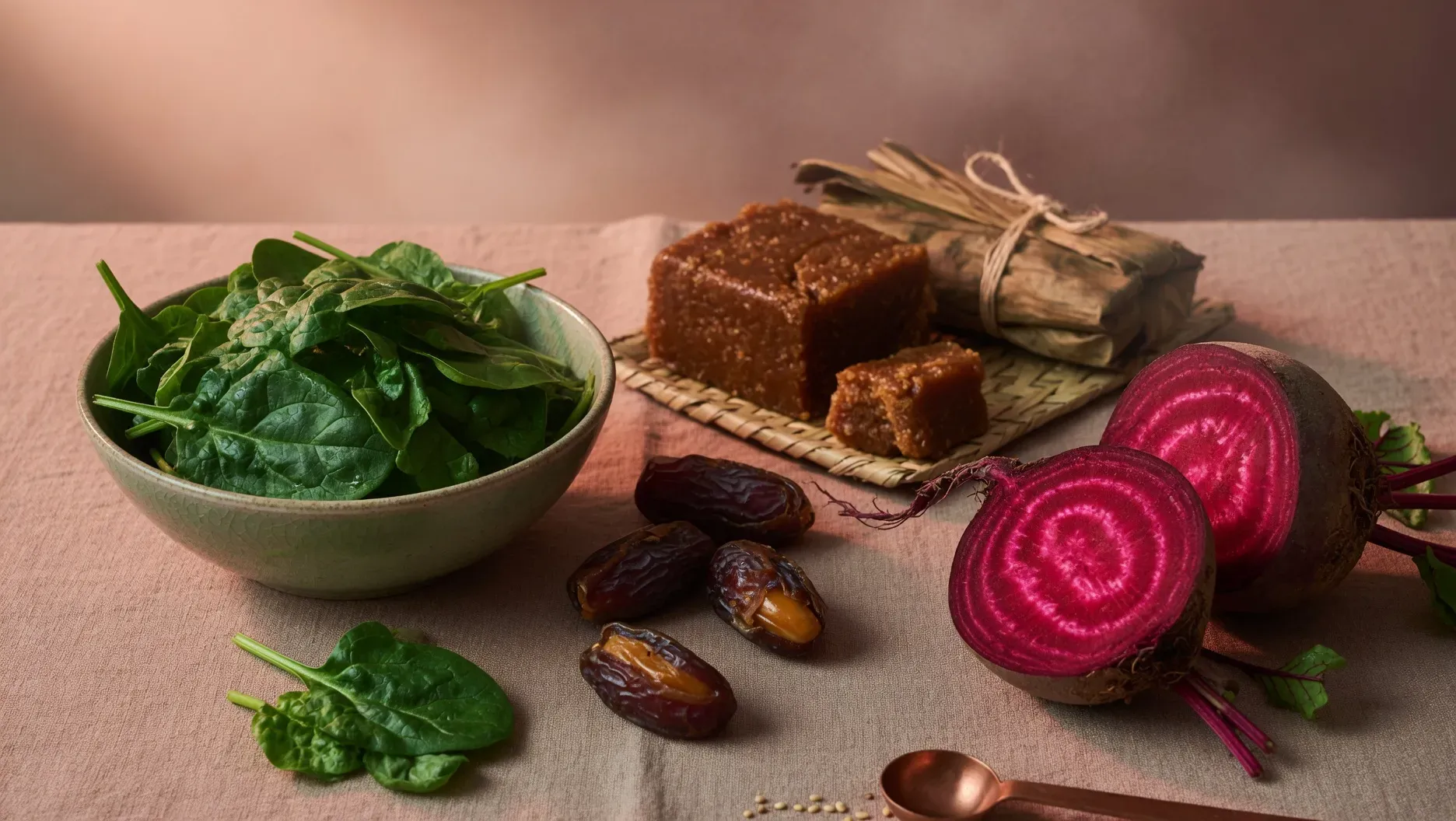
Eat iron-rich foods at every main meal. Dal is the foundation — masoor, moong, chana, toor, urad, rajma, lobiya. Leafy greens — cheera, spinach, drumstick leaves, methi. Seeds — sesame, pumpkin. Ragi. Meat and fish where included in the diet.
Pair every iron-rich meal with vitamin C. Lemon juice on dal and cooked greens, tomatoes in curries, a small glass of citrus juice alongside a meal. Vitamin C converts non-haem iron to a more absorbable form and can increase absorption by two to four times.
Move chai away from mealtimes. This single habit change is one of the most effective and consistently underused interventions for iron absorption in India. Aim for tea at least one hour before or after main meals.
Soak dal before cooking. Soaking reduces phytate content and improves mineral bioavailability. Most Indian households do this already, and it is worth continuing specifically for this reason.
Cook in cast iron. Traditional iron kadai and tawa cooking transfers measurable iron to food, particularly in acidic preparations.
Supplementation: the reality of what diet alone cannot do
Dietary strategies are important and they make a real difference — but for most women with diagnosed anaemia in pregnancy, dietary changes alone are not enough to restore haemoglobin levels quickly enough. Iron supplementation is the standard of care.
The government’s iron and folic acid tablet programme provides sixty mg of elemental iron alongside 500 mcg of folic acid daily through the antenatal system. Private providers often prescribe different formulations and doses depending on haemoglobin levels.
Managing side effects is important because side effects are the primary reason women stop taking supplements — and an iron supplement that isn’t taken doesn’t help. Nausea is reduced by taking iron with food rather than on an empty stomach. Many women find evening rather than morning dosing easier to tolerate. Constipation is managed with increased fibre and fluid intake; prune juice and ground flaxseed are practical additions. If a formulation causes severe side effects, tell your provider — different formulations exist, including ferrous bisglycinate, which is significantly better tolerated by most women.
Intravenous iron is recommended for women with severe anaemia, very low haemoglobin close to the time of delivery, or intolerance to oral iron. It is administered under medical supervision and replenishes iron stores much faster than oral supplementation. It is not available everywhere, but it is worth asking about if oral iron is not working or not being tolerated.
Do not exceed prescribed doses. Excess iron causes oxidative stress, interferes with zinc absorption, and can be harmful. The right dose is the one your provider has calculated for your specific haemoglobin level.
After delivery
Iron levels should be rechecked postpartum. Birth involves blood loss, and women who were anaemic during pregnancy are often more anaemic afterward. Continued supplementation in the postpartum period is usually recommended, and the traditional Kerala and South Indian postpartum foods — iron-containing preparations like drumstick, cheera, jaggery-based sweets, and urad dal — support recovery in ways that traditional communities have long understood.
Breastfeeding does not significantly deplete iron (breast milk is low in iron, but the mother’s iron is not significantly drawn upon for it). However, the physical demands of new motherhood on an already anaemic body are real, and postpartum iron repletion matters for recovery.
The honest message
Anaemia in pregnancy in India is common, it is serious, and it is manageable. The problem is not that nothing works — it is that the interventions that work require consistency: taking supplements even when they cause discomfort, adjusting tea habits, adding lemon to food, attending the follow-up appointments that confirm whether levels are improving.
These are not large or dramatic changes. They are small, consistent acts of care — for yourself and for a baby whose early health is built from the quality of your blood.
Get your haemoglobin tested. Know your number. Take the supplement if prescribed. Eat the iron-rich foods. Move the chai. And if levels are not improving at your follow-up, tell your provider so the approach can be adjusted.
This article is for general educational purposes only and does not replace personalised medical advice. Always consult your doctor, midwife, or a qualified healthcare professional about diagnosis and treatment of anaemia during your pregnancy.