
Pumsavana and Seemantham: Understanding Hindu Pregnancy Ceremonies
A guide to Pumsavana and Seemantham — two traditional Hindu pregnancy rituals, their meaning, timing, regional variations, and how families observe them today.
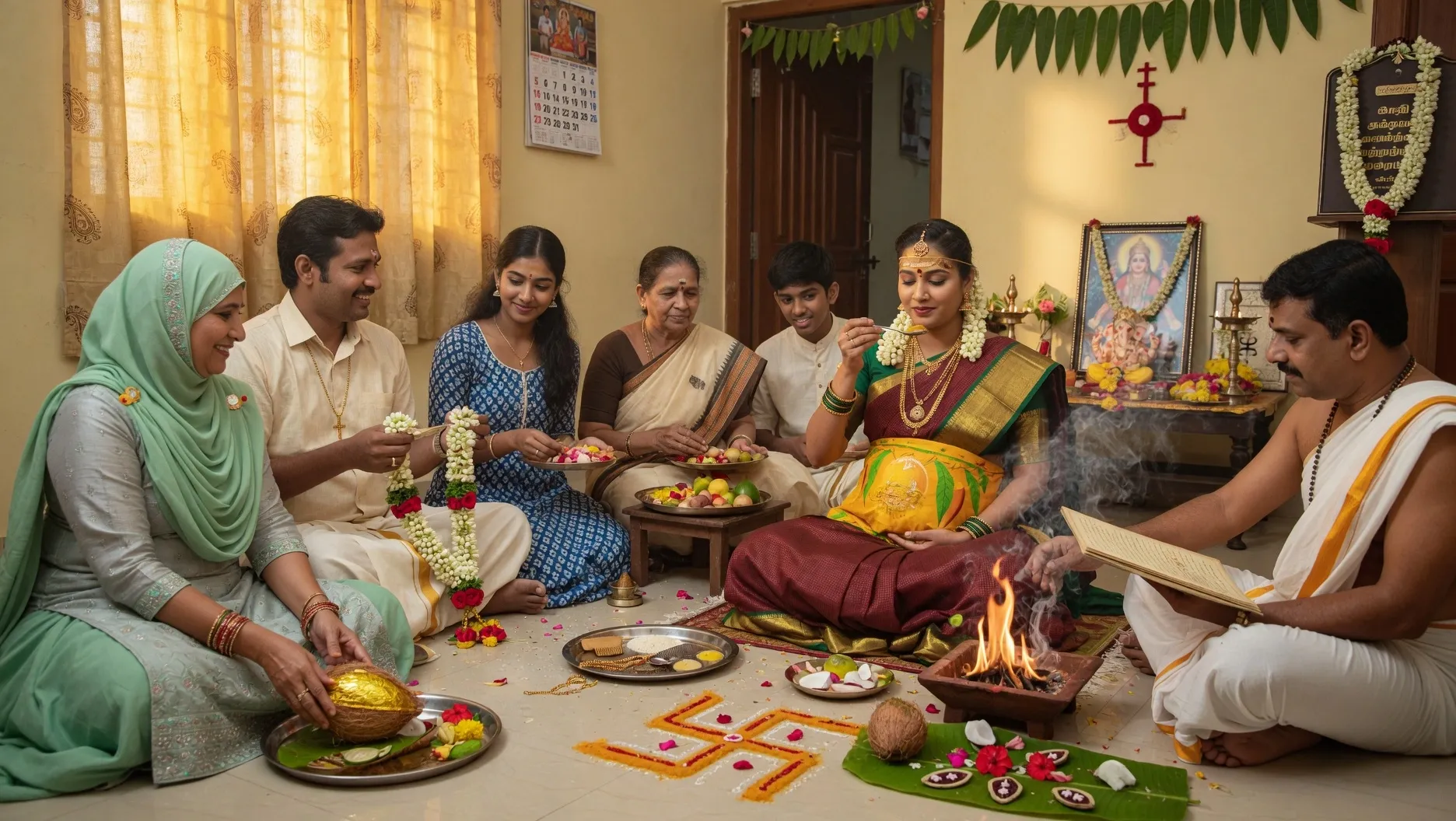
In the Hindu tradition, pregnancy is not a purely medical event. It is a sacred transition — the arrival of a new soul into the family and the world — and it is marked by rituals that have been observed, in various forms, for thousands of years.
Among the sixteen Samskaras — the rites of passage that mark significant stages of a Hindu life — two are specifically associated with pregnancy: Pumsavana and Seemantham. Together, they form a ceremonial arc that accompanies the journey from conception to birth, offering protection, blessing, and community at each stage.
Pumsavana — the ceremony of the second month
Pumsavana is traditionally performed during the second or third month of pregnancy, though some families observe it in the third trimester. The name comes from Sanskrit: pum (male child) and savana (bringing forth) — which reflects the ceremony’s ancient origins in a time when male children were particularly desired for religious and lineage reasons.
Today, Pumsavana is observed with the understanding that its deeper meaning is not about the sex of the child but about the health, protection, and wellbeing of the baby. The ceremony is a prayer for a healthy pregnancy and a safe birth.
Traditional elements of Pumsavana may include:
- Prayers and mantras recited by a priest or family elder, invoking protection for the mother and child
- Application of specific herbs or preparations — banyan tree shoots and other plant-based substances are referenced in classical texts, though the specific practices vary considerably by region and tradition
- Offerings to the family deity
- Blessings from elder women in the family
In many contemporary Hindu families, particularly in South India, Pumsavana has been absorbed into or combined with Seemantham — observed as a single ceremony rather than two separate ones. In other families, it is observed separately with full ritual specificity. The variation is wide, and what matters most in any given family is the intention behind the observance rather than adherence to a single prescribed form.
Seemantham — the parting of the hair ceremony
Seemantham — also called Simantonnayana in Sanskrit — is the more widely observed of the two ceremonies and the one more commonly marked with a family gathering. It is traditionally performed in the fourth, sixth, or eighth month of pregnancy (even months are considered auspicious in South Indian tradition).
The central ritual of Seemantham involves the parting of the pregnant woman’s hair — typically performed by her husband — with a porcupine quill, a stick of fig wood, or a bunch of darbha grass, accompanied by specific mantras. The hair parting is understood as a gesture of care and protection, opening a pathway for wellbeing to enter.
In practice, the full ritual as described in classical texts is rarely performed in its entirety in contemporary families. What most families observe is the spirit of Seemantham rather than its precise textual form — a gathering of family and community, prayers for the mother and child, blessings from elder women, ritual preparations of the mother (application of turmeric, adornment with flowers and jewellery), and a shared meal.
In South India, particularly in Tamil and Telugu communities, Seemantham is closely related to Valaikappu — the bangle ceremony. The two are sometimes performed together or used interchangeably in common usage, though they are technically distinct ceremonies from different textual traditions.
What these ceremonies mean in practice
The theological dimensions of Pumsavana and Seemantham — the mantras, the specific ritual materials, the precise timing — belong to the Vedic tradition and are best understood with guidance from a family priest or a knowledgeable family elder.
But the human dimensions are more universally accessible. These ceremonies exist to do several things that the Vedic tradition understood to be genuinely important:
To mark the pregnancy publicly. Before Seemantham, a pregnancy may be known but not yet formally acknowledged by the community. After it, the mother has been blessed and celebrated, and the coming child has been welcomed.
To surround the mother with elder women who have navigated what she is navigating. The gathering of women around the pregnant mother — the grandmothers, aunts, and experienced mothers who offer their presence and their blessing — is a form of social support whose psychological value is real and significant.
To express the family’s love and intention for the new life. Whatever the theological framework, the act of gathering to pray for a healthy birth and a healthy child is an expression of love. The ritual gives that love a form.
Observing these ceremonies today
How Hindu families observe Pumsavana and Seemantham today varies enormously — by region, by community, by generation, and by individual family culture.
Some families observe the ceremonies with full traditional ritual, including a priest, the specific mantras, and the precise timing determined by the family jyotishi or astrologer. Others observe a simplified version — the gathering, the blessings, the shared meal — without the full ritual structure. Others have blended these traditions with contemporary baby shower elements. And some families do not observe them at all.
None of these positions is wrong. Tradition is most meaningful when it is observed with genuine understanding and intention rather than performed as obligation. If Pumsavana and Seemantham are part of your family’s practice, receive them with the understanding of what they are offering. If they are not, the values they embody — community, blessing, love for the new life — are worth seeking in whatever forms your family expresses them.
A word about family pressure
For some expecting mothers, these ceremonies are a source of joy. For others, they can come with family pressure — pressure to observe them in a specific way, at a specific time, with specific guests — that adds to the logistical and emotional load of pregnancy rather than lightening it.
If you are navigating that kind of pressure, it is worth separating two questions: what do you want from this ceremony, and what is the family trying to express through it? Usually the family’s intention is love, even when the expression of it is stressful. Finding a way to honour the intention — the gathering, the blessing, the acknowledgement — while protecting your own energy and wellbeing is not a rejection of tradition. It is simply good sense during a pregnancy.
This article is for cultural and educational purposes. Ritual practices vary widely between Hindu communities, regions, and families. The information here is general and should be understood in the context of your own family tradition.