Safe Pregnancy Exercises: Staying Active by Trimester
Simple guidance for walking, yoga, stretching, breathing, and trimester-safe movement during pregnancy.
Nobody tells you how complicated the word “exercise” becomes when you’re pregnant.
Before pregnancy, movement was straightforward — you either did it or you didn’t. During pregnancy, it turns into a series of questions. Is this safe right now? Am I pushing too hard? Should I be doing more? Is it okay that I skipped three days because I was exhausted? Is the fatigue a sign I need rest or a sign I need to move?
The honest answer is that staying active during pregnancy is genuinely worth it — for your energy, your mood, your sleep, your circulation, your posture, and your body’s preparation for birth. But the right approach to pregnancy exercise is not about performance or hitting a target. It’s about building something gentle, consistent, and honest enough to actually fit into how pregnancy feels — week by week, trimester by trimester.
Mommy: Pregnancy Care & Guide includes safe exercise suggestions — walking, prenatal yoga, swimming, stretching, pelvic floor work, relaxation, and breathing — so that staying active feels approachable rather than another thing on an already long list.
Before you start — please read this part
Exercise during pregnancy is safe and beneficial for most women. But most is not all, and your specific situation matters.
Always follow your doctor’s guidance before starting or changing a routine — especially if your pregnancy is high-risk, if you’ve had bleeding, dizziness, severe pain, placenta concerns, high blood pressure, or any other condition where movement may need to be limited or modified.
Stop exercising and contact your healthcare provider if you experience chest pain, faintness or dizziness, severe shortness of breath, regular painful contractions, fluid leaking, vaginal bleeding, or sudden swelling in your face, hands, or feet.
These are not small symptoms to push through. They are signs to stop and get help.
First trimester: gentle is enough
The first trimester asks a lot of your body — even when it doesn’t look like it from the outside. Growing a placenta, shifting hormones, managing nausea and exhaustion — all of that is work, even on the days when you barely leave the couch.
This is not the trimester to establish an ambitious new fitness routine. It is the trimester to stay gently moving when you can, and to rest without guilt when you need to.
Movements that tend to work well in the first trimester:
- Short, easy walks — even ten minutes counts
- Gentle stretching, especially for the neck, shoulders, and hips
- Slow breathing exercises, which also help with nausea and anxiety
- Light mobility work if you feel up to it
- Genuine rest on the days when your body is asking for it
The goal here is comfort and consistency — not intensity. If nausea is strong, lying down and doing a few gentle deep breaths counts as taking care of yourself. That’s not nothing.
Second trimester: the window most people talk about
The second trimester is often when things feel more manageable. For many women, the worst of the early nausea has settled, energy has improved, and the bump is visible but not yet uncomfortable enough to limit movement significantly.
If there’s a trimester to build a gentle routine, this is usually it.
Movement that can be particularly helpful in the second trimester:
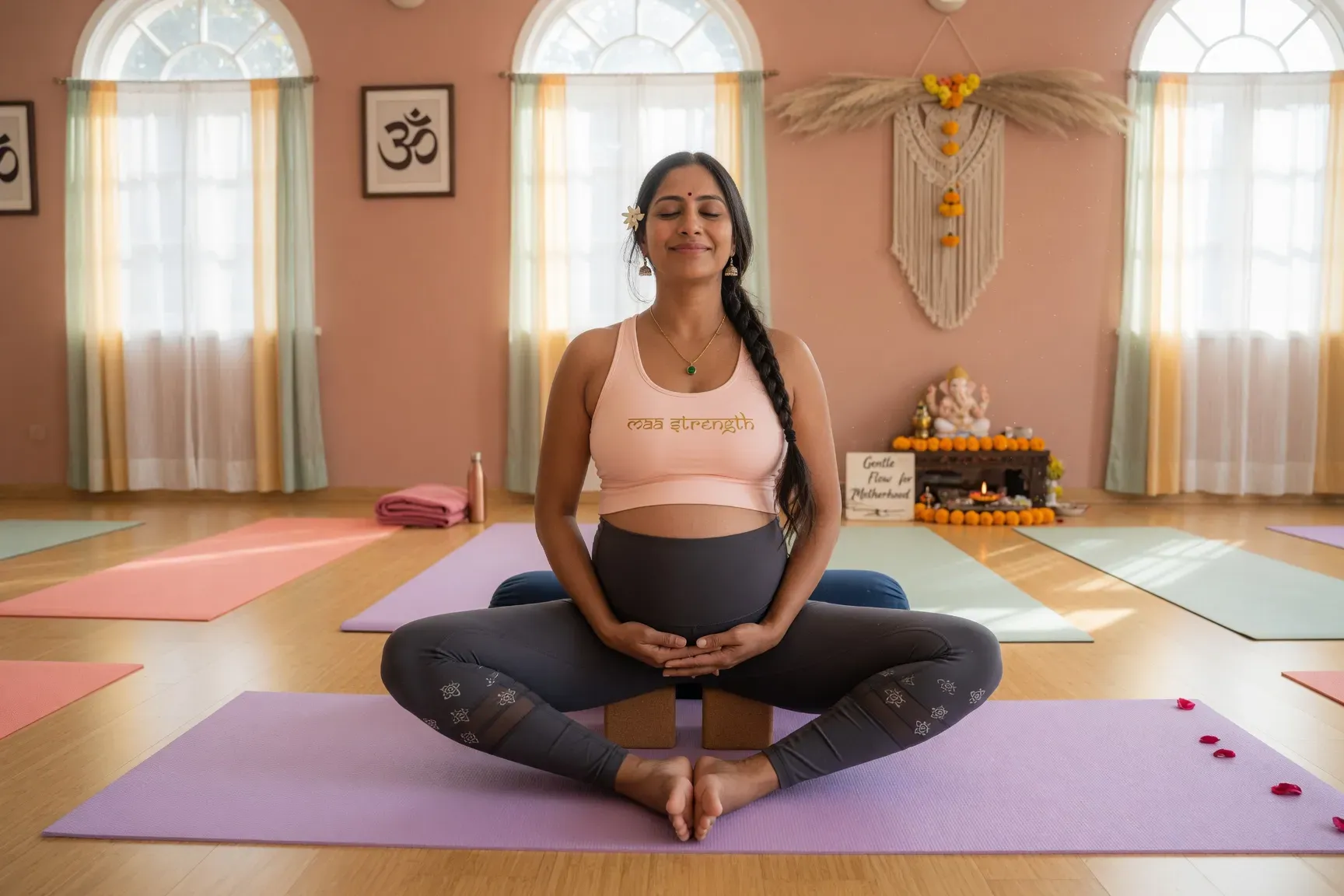
- Prenatal yoga — for flexibility, breathing, posture, and the mental reset it provides
- Walking, which supports circulation and energy without the impact of higher-intensity exercise
- Swimming or water aerobics, which takes the weight off your joints entirely
- Light strength work — if your provider has approved it — focusing on posture and endurance rather than load
- Pelvic floor exercises, which are worth starting now if you haven’t already
A few things to be mindful of as your bump grows: your centre of gravity is shifting, which affects balance. Avoid exercises that feel unstable, movements that require lying flat on your back for extended periods, and anything that causes overheating or leaves you dehydrated. Drink water before, during, and after movement — more than you think you need.
Third trimester: comfort, circulation, and preparation
By the third trimester, movement looks different — and that’s completely normal. Your body is doing something extraordinary, and the physical reality of that changes what exercise feels like and what it’s for.
The focus now shifts from building fitness to maintaining comfort, supporting circulation, managing the aches that come with carrying a baby, and preparing your body and mind for birth.
Shorter sessions often work better than longer ones. A twenty-minute walk might feel like enough — because it is enough. A few minutes of hip stretches before bed might be the most useful thing you do all day.
Movement that tends to support the third trimester well:
- Walking at a pace that feels genuinely comfortable — not a pace you’re maintaining out of habit
- Hip and lower back stretches, which can bring real relief as the baby’s weight increases
- Deep breathing and relaxation exercises, which are as much about mental preparation as physical
- Gentle prenatal yoga adapted for the third trimester, with modifications for your bump
- Pelvic floor awareness — connecting with and gently strengthening the muscles that will matter during labour
- Rest, intentionally built into your week rather than treated as a sign you’ve fallen behind
A slower day is not a setback. In the third trimester especially, rest is part of the work.
Building a weekly routine that you’ll actually stick to
The best pregnancy exercise routine is not the most ambitious one. It’s the most realistic one — the one that fits into the week you actually have rather than the week you planned.
A gentle, sustainable weekly structure might look something like this:
- 10 to 20 minutes of walking on the days it feels manageable
- A few minutes of stretching after long periods of sitting or sleeping
- A short breathing practice before bed, especially on anxious nights
- Pelvic floor exercises worked into daily moments — waiting for the kettle, sitting at a desk
- At least one full rest day, taken without guilt whenever your body signals it needs one
Mommy: Pregnancy Care & Guide’s activity tools are designed to make this approachable — with exercises labelled by duration, difficulty level, and trimester so you can find something that matches where you are today, not where you think you should be.
The mindset shift that actually helps
Pregnancy exercise works best when you stop thinking of it as exercise and start thinking of it as care.
You’re not training. You’re not maintaining a fitness baseline or compensating for the days you didn’t move. You’re doing something gentler and more honest than that — you’re supporting your body through something it has never done before, keeping it comfortable and capable, and preparing it for the work of birth and recovery.
Movement is part of that care. So is rest. So is a ten-minute walk on a day when a ten-minute walk is all you have. So is lying on the couch with a pillow between your knees because that’s what your body needed today.
The right routine is the one that keeps you safe, comfortable, and realistic enough to come back to it tomorrow.
This article is for general educational purposes only and does not replace professional medical advice. Always speak with your doctor, midwife, or a qualified physiotherapist about what movement is appropriate for your specific pregnancy.