
The Role of the Joint Family System During Pregnancy: Support, Pressure, and Boundaries
An honest guide to navigating pregnancy in an Indian joint family — the genuine support it offers, the pressures it can create, and how to protect your wellbeing while maintaining relationships.
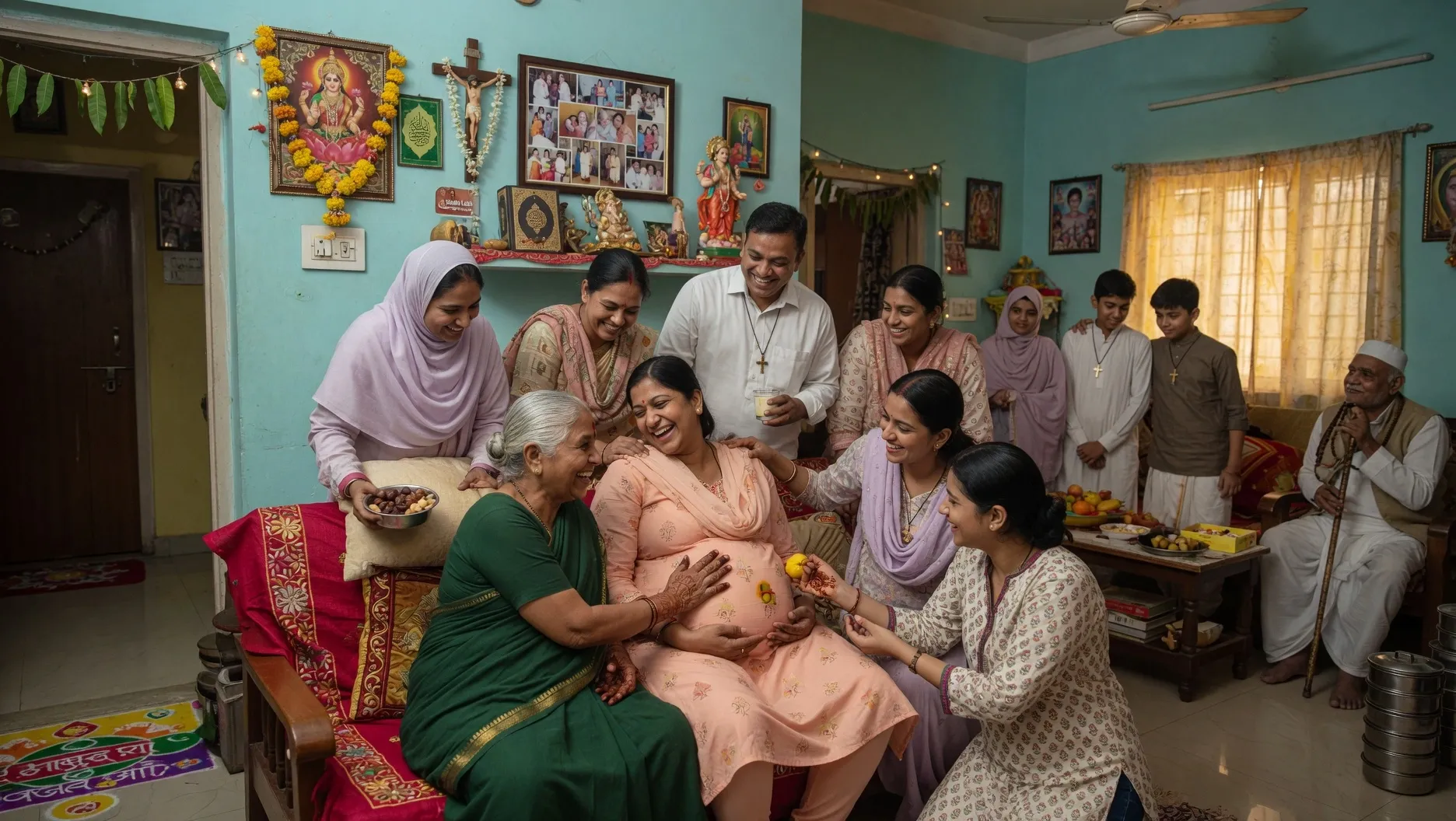
Pregnancy in India is rarely a private experience. In a country where the joint family system remains the dominant household structure — where grandparents, aunts, uncles, and cousins are often present not just at celebrations but in daily life — carrying a child is a shared event in a way that most Western pregnancy content doesn’t quite capture or prepare you for.
This has genuine advantages. It also has genuine challenges. And being honest about both, without romanticising the family or dismissing its importance, is what actually helps expecting mothers navigate it.
What the joint family genuinely offers during pregnancy
For all the complexity it introduces, the joint family during pregnancy can offer something that is increasingly rare in more individualised living arrangements: you are not alone.
Practical support that matters daily. In the first trimester, when nausea is severe and fatigue is overwhelming, having family members who cook without being asked, who take over household responsibilities without a negotiation, who notice that you haven’t eaten and bring you something — this is not a small thing. It is the kind of support that makes a hard trimester genuinely more manageable.
The presence of experience. Your mother-in-law has been pregnant. Your mother has been pregnant. Your aunts have been pregnant. Not all of their advice will be correct by modern medical standards, but their presence — their lived knowledge that this is survivable, that the discomfort passes, that the exhaustion has an end — has genuine value. There are questions you can ask a woman who has given birth that you cannot ask a doctor, and having those women nearby is a resource.
Care during recovery. The postpartum period in a joint family is often structured around the new mother’s recovery in a way that the nuclear family context — where the exhausted parents are alone with a newborn — simply cannot match. The traditional Kerala postpartum practices of special food, rest, and family care (sometimes called the 40-day period) are genuinely supported in joint family settings in a way that is difficult to replicate otherwise.
Shared childcare. The involvement of grandparents and family in childcare — once the baby arrives — reduces the isolation of early parenthood and provides the baby with multiple attachment figures and consistent love.
The pressures that are equally real
The same proximity that creates support also creates pressure. This is not a flaw in the joint family as a concept — it is an inherent feature of close living, multiplied by the heightened stakes of pregnancy and new parenthood.
Unsolicited advice and conflicting guidance. You will receive advice. All the time. From everyone. Some of it will conflict with your doctor’s advice. Some of it will conflict with other advice you received twenty minutes earlier. The challenge is not that the advice comes from a bad place — it almost always comes from genuine concern — but that navigating it while also managing a pregnancy requires emotional energy you may not always have.
Loss of privacy and autonomy. Decisions that feel like they should belong to you — what to eat, how to rest, whether to attend a family event, how to manage a symptom — can become family negotiations in a joint household. The expectation that pregnancy is a shared experience can blur into an expectation that pregnancy decisions are shared decisions, which is a different thing.
Cultural and generational expectations. Traditional beliefs about pregnancy — about what you should eat, how you should rest, what ceremonies should be observed, how you should behave — can create pressure that ranges from mildly stressful to genuinely difficult if they conflict significantly with your own preferences or with medical advice.
The husband’s complicated position. In many Indian joint family situations, the husband is simultaneously the support you need and a person with his own family obligations and loyalties that can sometimes pull in a different direction. This can create a particular kind of loneliness — being surrounded by family while still feeling like your primary advocate is not fully in your corner.
Relationship strain between you and your mother-in-law. This does not need to be stated in euphemisms. The relationship between a pregnant woman and her mother-in-law in a joint family setting is one of the most consistently cited sources of pregnancy stress in Indian women. The causes are structural as much as personal — two women with different knowledge, different authority, and different emotional investment in the same pregnancy navigating a shared household. It doesn’t always go smoothly.
What boundaries actually mean in an Indian family context
The word “boundary” has entered common usage in discussions of relationships, but in the Indian family context it can feel foreign or even disrespectful — as if setting a boundary means rejecting the family’s care and involvement.
A more useful frame might be: clarity. Being clear about what you need. Being clear about what is working and what isn’t. Being clear about where your doctor’s guidance is non-negotiable. Clarity is not rejection — it is honesty, and it tends to work better in Indian family contexts than the more confrontational framing that “setting boundaries” can imply.
Some practical approaches:
Use your doctor as a neutral authority. When traditional advice conflicts with medical guidance, your doctor’s recommendation is not one opinion among many — it is medical advice that applies to your specific pregnancy. “The doctor said I need to rest / eat this / avoid that” is a sentence that carries weight in Indian family settings in a way that “I prefer to” does not always. This is not dishonest — it is communicating medical advice in the form that is most likely to be heard.
Be specific about what help you actually want. “I need help” is easy to misinterpret. “It would really help me if someone could make dinner three nights a week” or “I need to rest for an hour after lunch and need the house to be quiet” is specific enough to be acted on and less likely to result in help that feels like intrusion.
Talk to your husband directly and specifically. Your husband needs to understand that his role during pregnancy is primarily to you — not to mediate equally between you and his family. This is a conversation worth having explicitly and calmly, preferably before a conflict arises rather than in the middle of one.
Find an ally in the family. In most families, there is at least one person — a sister-in-law, an aunt, your own mother — who can be a quiet ally. Someone who can redirect overly intrusive concern, who can explain to the family when you need space, and who can advocate for you in conversations you are not part of.
Accept the help that is genuinely helpful and ask for changes where they aren’t. Not every family interaction during pregnancy is a boundary to be defended. A lot of it is love, expressed in ways that are imperfect because all love is. Receiving the help that genuinely helps — the cooking, the company, the experienced presence — while being clear about what isn’t working is not a compromise of your autonomy. It is living in a family.
When the pressure is genuinely too much
For some women in some families, the pressure during pregnancy goes beyond the normal friction of close living. It looks like decisions being made about your pregnancy without your input. It looks like your medical appointments being attended by family members who then override your preferences. It looks like food restrictions being imposed that are causing you nutritional harm. It looks like a level of conflict with your mother-in-law or your husband’s family that is affecting your sleep, your eating, and your mental health.
If the family environment during your pregnancy is genuinely harmful to your wellbeing — not just occasionally stressful, but consistently so — that is worth taking seriously. Chronic stress during pregnancy has real physiological effects. Protecting your mental and physical health is not selfishness. It is appropriate care for yourself and your baby.
If you are in this situation, talking to your doctor honestly — about your living situation as well as your physical symptoms — is a good starting point. Some obstetric practices in India have social workers or counsellors available. Your own parents or a trusted friend outside the household can also be a resource.
You do not have to manage a difficult family environment alone during pregnancy any more than you have to manage a difficult physical symptom alone.
The honest conclusion
The joint family during pregnancy is not simply a support system or simply a source of pressure. It is both, in proportions that vary enormously between families and between pregnancies within the same family.
The goal is not to love the joint family uncritically or to distance yourself from it in the name of independence. The goal is to receive what it genuinely offers — the care, the experience, the practical help, the love — while being honest and clear about what isn’t working, before the friction becomes conflict and the conflict becomes something harder to repair.
You are going to need this family. The baby you are carrying is going to be shaped by these relationships for their entire life. Navigating it thoughtfully during pregnancy — with honesty, with clarity, and without either total surrender or total resistance — is one of the most valuable things you can do for yourself and for your child.
This article is for general informational and emotional support purposes. If you are experiencing significant emotional distress, domestic conflict, or mental health concerns during pregnancy, please speak with your doctor or a qualified counsellor.