
Folate and Folic Acid in Indian Cooking: What to Eat Before and During Pregnancy
A practical guide to folate in Indian foods, why it matters before conception, and how South Asian cooking already supports your needs.
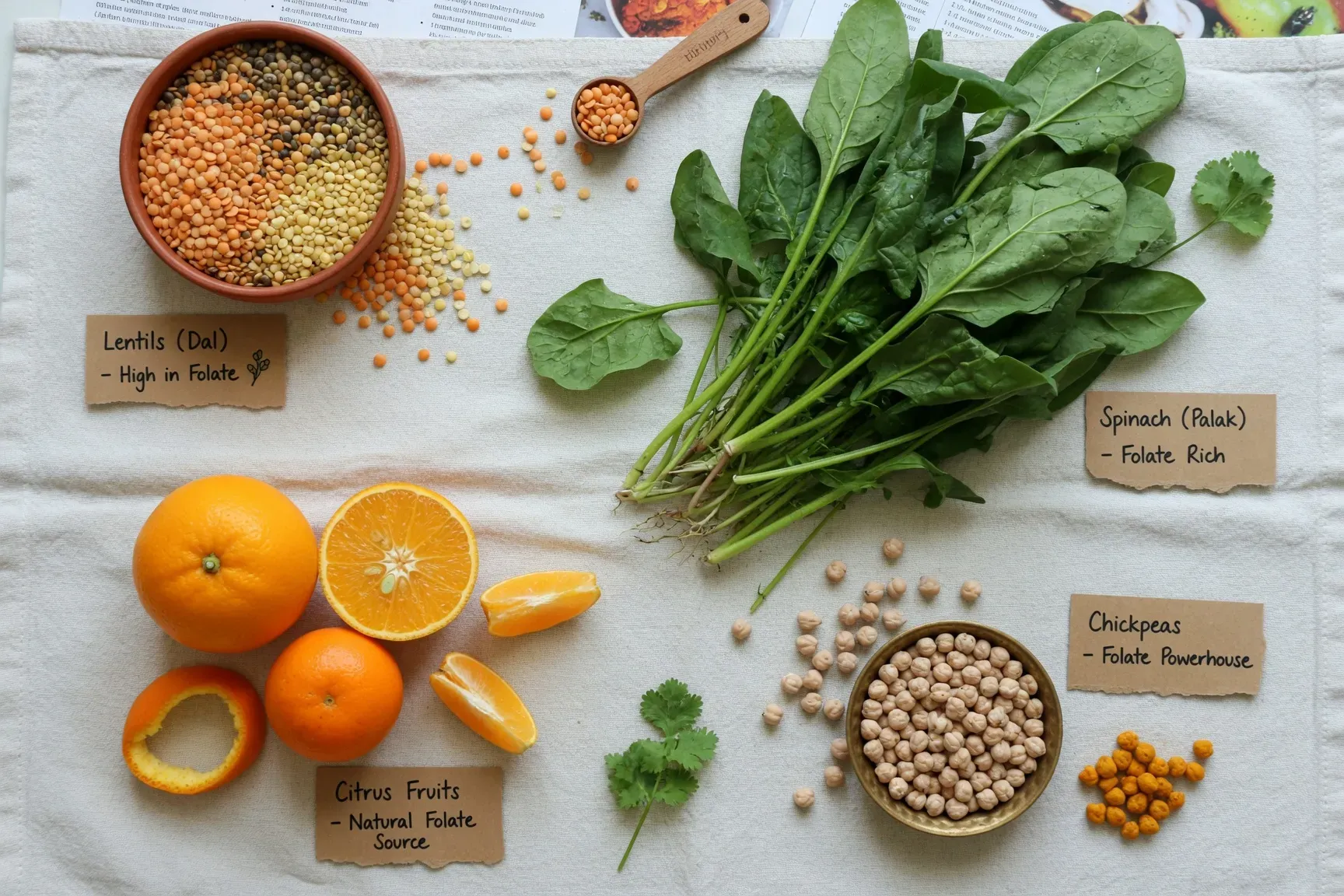
Of all the nutrients associated with pregnancy, folate is the one with the most urgent timeline.
Most of the others — iron, calcium, DHA, protein — matter consistently across the forty weeks of pregnancy. Folate matters most in a window that begins before most women know they are pregnant. The neural tube, which develops into the baby’s brain and spinal cord, closes between the third and fourth week after conception. Neural tube defects — conditions like spina bifida — are closely linked to inadequate folate during this early period. By the time a missed period signals that a pregnancy has begun, that window is already partway through.
This is not said to cause alarm. It is said because understanding the timeline helps explain why folate advice tends to feel more urgent than advice about other nutrients, and why the recommendation to take folic acid supplements begins at the point of trying to conceive rather than at a positive pregnancy test.
The other reason this matters is that folate is not a nutrient the body stores in large amounts. It is water-soluble, which means it needs to be replenished regularly through food and, in pregnancy, through supplementation. And yet the Indian kitchen — with its reliance on dal, dark leafy greens, and legumes — is one of the most naturally folate-rich food environments in the world. With a little attention to how and what you’re eating, this is a nutrient you can genuinely address through food.
The difference between folate and folic acid
These two words are often used interchangeably, and they refer to the same essential nutrient — but they’re not exactly the same thing.
Folate is the naturally occurring form found in food. It is present in lentils, leafy greens, chickpeas, and a range of other whole foods.
Folic acid is the synthetic form used in supplements and in food fortification. It is actually more readily absorbed than natural folate from food — which is why supplementation remains recommended even when dietary folate intake is good.
When your doctor or midwife recommends a folic acid supplement before and during pregnancy, they mean the synthetic form, because the absorption rate is more predictable and the doses can be standardised. This does not mean food folate is unimportant — it is very important — but it does mean that supplements and dietary sources serve complementary roles rather than interchangeable ones.
Why food sources still matter — even if you’re supplementing
If you are taking a folic acid supplement as recommended, you might reasonably wonder whether you need to think about dietary folate at all. The answer is yes, for a few reasons.
First, the supplement provides a reliable baseline, but dietary folate from food contributes additional amounts that collectively support the body’s needs throughout pregnancy, not just in the early weeks.
Second, folate from food comes packaged with other nutrients — lentils provide protein and iron alongside folate; leafy greens provide calcium and vitamin K; chickpeas provide fibre and slow-release carbohydrate. Eating folate-rich food means eating broadly well, not just targeting a single nutrient.
Third, folate continues to matter beyond the first trimester. It is involved in DNA synthesis and cell division throughout pregnancy, which means consistent dietary intake matters right through to the end.
The best folate-rich foods in an Indian kitchen
This is where the good news is: the foods at the heart of traditional South Asian cooking are among the best dietary folate sources available.
Lentils and legumes
- Masoor dal (red lentils) — excellent folate content, easy to cook, digestible in early pregnancy
- Moong dal — lighter and easy on the stomach, good during the first trimester
- Chana dal and whole chickpeas — high folate content; useful in curries, chaats, and stews
- Rajma (kidney beans) — a strong folate source, particularly good in the second trimester when appetite has returned
- Urad dal — used daily in idli and dosa batters; a consistent and underappreciated source
- Black-eyed peas (lobiya) — notably high in folate, versatile as a dry curry or added to rice dishes
Eating dal once or twice daily — which is already the pattern in most South Indian and Kerala households — provides a meaningful and consistent contribution to your folate intake.
Dark leafy greens
- Spinach (palak) — one of the most folate-rich vegetables available; effective cooked or added to dal
- Drumstick leaves (murungai keerai) — exceptional folate density, commonly used in sambar across Kerala and Tamil Nadu
- Amaranth (cheera) — a Kerala kitchen staple with significant folate content; prepared as thoran or in curries
- Fenugreek leaves (methi) — good folate content; use in culinary amounts through pregnancy
- Coriander (dhania) — the fresh herb used as garnish is a modest but consistent folate contributor when used generously
Other vegetables
- Broccoli and asparagus — higher in folate than most vegetables; not always traditional but increasingly available and worth including when you can
- Okra (bhindi) — good folate content and easy to prepare in a range of ways
- Beetroot — notable folate source; useful roasted, in curries, or as juice
- Avocado — good folate content; though not traditional to Kerala cuisine, it has become more available and can be a useful addition
Fruits
- Papaya (ripe) — provides folate alongside vitamin C; ripe papaya in moderate amounts is considered safe during pregnancy
- Mango — a natural source of folate; welcome news given how much it is eaten in season across South India
- Citrus fruits — oranges, sweet lime (mosambi), and lemons all contribute useful folate alongside vitamin C
- Guava — one of the most folate-rich fruits available; commonly eaten and easy to include daily
Fortified foods
Many packaged cereals, breads, and atta (wheat flour) are now fortified with folic acid. These can contribute to intake when included in the diet, though whole food sources remain preferable as a primary approach.
Before conception: eating for folate when you’re planning a pregnancy
If you are planning to conceive, this is the ideal time to start both supplementing and building food habits that support early pregnancy. The recommendation to begin folic acid supplementation at least one month before trying to conceive — and ideally three months before — exists precisely because of that early neural tube timeline.
In practical terms, this means:
- Starting a folic acid supplement as soon as you begin trying, or as soon as a pregnancy is being planned
- Increasing the frequency of dal, leafy greens, and legumes in your regular diet
- Making guava, citrus fruit, and mango (in season) a regular snack habit
- Reducing foods and habits that deplete folate — excessive alcohol (ideally eliminated entirely), very high heat cooking that destroys folate in vegetables, and a diet very high in heavily processed foods
If your pregnancy was unplanned, start supplementation as soon as you know and speak to your provider about dosage. The body responds to folate intake quickly, and starting immediately still makes a meaningful difference.
First trimester: folate when you can barely eat
The first trimester is the most critical window for folate — and often the hardest period to eat well in.
When nausea is controlling your diet, the goal is to get folate into your body in whatever forms are tolerable. Some options that tend to survive the first trimester:
- Moong dal soup — very lightly spiced, easy on the stomach, folate-providing
- Guava — often tolerated even when other foods aren’t; eat it whole or as a simple snack
- Orange or sweet lime — vitamin C and folate in a form that many women find refreshing rather than nauseating
- Plain idli with minimal accompaniment — the urad dal base provides folate even in its fermented, mild form
- Banana — modest folate content but genuinely easy to eat on difficult days
- Fortified cereal or oats — bland, easy, and folate-containing
The supplement is particularly important in this trimester precisely because eating is inconsistent. Take it with food if it worsens nausea, and tell your provider if you’re struggling to keep it down — there are solutions.
Second and third trimesters: building consistency
Once nausea has settled, the second trimester is the time to establish eating patterns that reliably include folate-rich foods — not as a special project, but as a rhythm.
The simplest version of this looks like:
- Dal at lunch or dinner (or both)
- A cooked leafy green — cheera thoran, palak in dal, murungai sambar — most days
- Fresh fruit that includes citrus or guava regularly
- A garnish of fresh coriander and a squeeze of lemon on food as a standard habit
These are not additions to a normal diet. For most women cooking in a Kerala or South Indian kitchen, they are already the structure of daily eating — which means folate, from a dietary perspective, may already be better handled than you think.
A note on folate and heat
Folate is sensitive to heat, and prolonged high-temperature cooking reduces the folate content of food. This is worth knowing without overreacting to — you don’t need to eat raw lentils. But it does mean:
- Pressure cooking vegetables for shorter times preserves more folate than long slow boiling
- Lightly cooked greens (a quick thoran, a brief sauté) retain more folate than greens simmered for a long time
- Fresh fruit and raw vegetables, where part of the diet, contribute folate that hasn’t been affected by heat at all
What good folate nutrition looks like
It looks like dal most days. A leafy green most days. Citrus fruit or guava as a regular presence in your meals. Fresh coriander as a garnish that you don’t think twice about. And a folic acid supplement taken as your provider has advised, from before conception through at least the first trimester and often beyond.
The Indian kitchen already does much of this work. The supplement covers what food alone cannot guarantee, particularly in those earliest, most critical weeks. Together, they provide what folate nutrition in pregnancy actually requires — not perfection, just consistency.
This article is for general educational purposes only and does not replace personalised nutrition or medical advice. Always consult your doctor, midwife, or a qualified healthcare professional about your specific dietary needs during pregnancy.