Fetal Positions in the Third Trimester: What They Mean for Labour
A clear guide to fetal positions in late pregnancy — what cephalic, breech, transverse, and occiput positions mean, how they are assessed, and what can be done about them.
As pregnancy moves into the third trimester, the position of the baby in the uterus begins to matter in a practical way: the position the baby is in at the time of labour significantly affects how labour progresses and how birth unfolds.
Understanding the different positions, what they are called, when position becomes relevant, and what the options are when a baby is not in the most favourable position gives you the context to follow what your provider is assessing in late pregnancy appointments and to understand the conversations about labour that begin to happen as the due date approaches.
How position is assessed
Fetal position in the third trimester is assessed through two main methods:
Abdominal palpation (Leopold’s manoeuvres): Your provider places their hands on your abdomen in a systematic sequence, feeling for the baby’s head, back, and limbs. An experienced provider can usually determine fetal position from palpation alone from around thirty-six weeks. Earlier in the third trimester, position is less fixed and less clinically relevant.
Ultrasound: Confirms position definitively. Often done as part of routine third-trimester scanning or when the clinical assessment is uncertain.
Engagement: Separately from position, providers assess whether the baby’s presenting part (whatever is lowest in the uterus) has engaged — begun to descend into the pelvis. In first pregnancies, engagement often occurs two to four weeks before labour; in subsequent pregnancies it may not happen until labour begins.
The positions: what they mean
Cephalic (head-down)
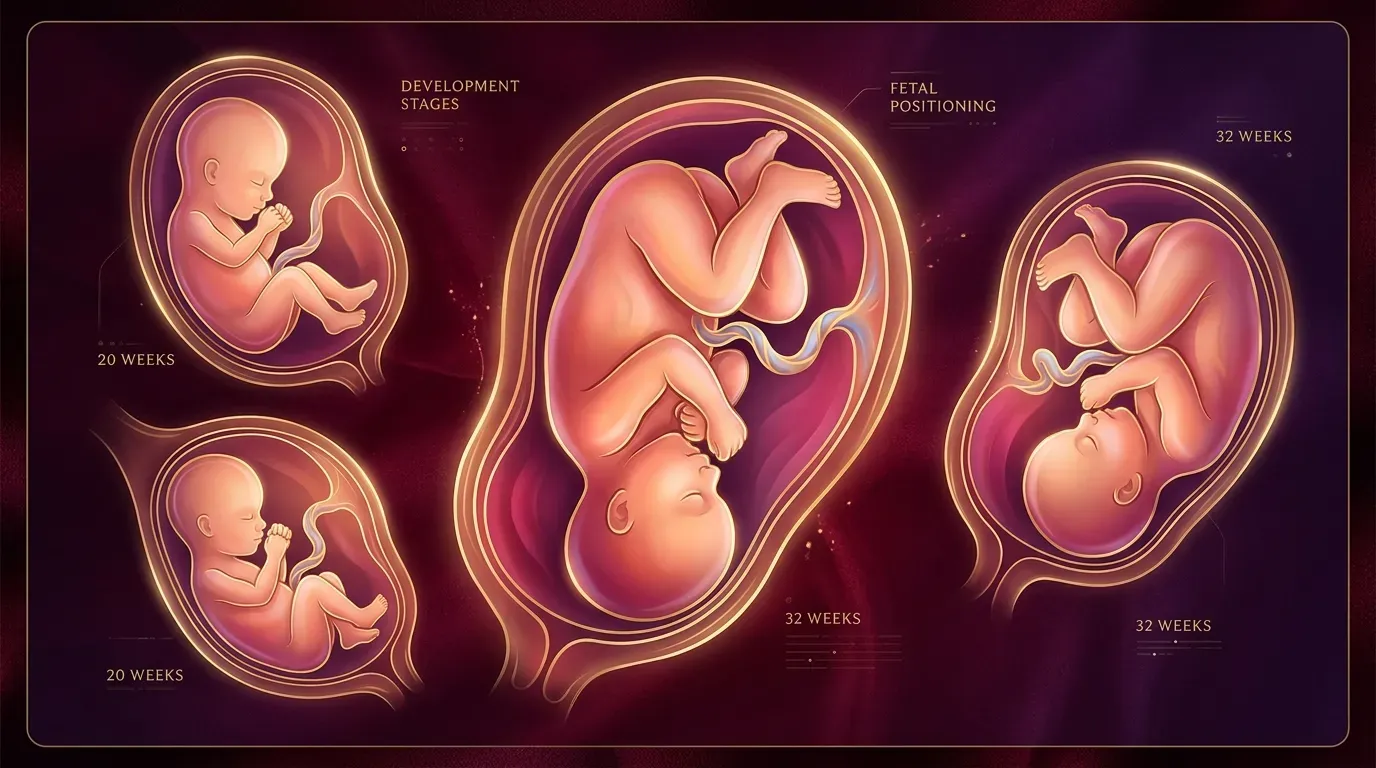
The ideal position for vaginal birth. The baby’s head is at the bottom of the uterus, positioned to be the first part through the pelvis and birth canal. Approximately ninety-five to ninety-six percent of babies at term are in a cephalic position — the uterus naturally accommodates the baby in this orientation because the head is the heaviest part and gravitates downward.
Within cephalic presentations, the direction the baby is facing matters for how labour progresses:
Occiput anterior (OA) — the most favourable position. The back of the baby’s head (occiput) faces forward — toward the mother’s abdomen. The baby is facing her spine. In this position, the smallest diameter of the baby’s head presents to the pelvis, and labour tends to progress most efficiently. Left occiput anterior (LOA) and right occiput anterior (ROA) are the two specific variants, depending on which side the baby’s back is toward.
Occiput posterior (OP) — the “back to back” position. The baby’s back is against the mother’s back, and the baby faces forward — toward the mother’s abdomen. This is sometimes called the “back to back” or “sunny side up” position. Labour with an OP baby tends to be longer and often more uncomfortable (particularly in the lower back) because the larger diameter of the head presents to the pelvis, and the baby needs to rotate during labour to navigate the birth canal. Many OP babies do rotate during labour and deliver vaginally without difficulty; some do not.
Occiput transverse. The baby is facing sideways — neither fully anterior nor fully posterior. Many babies begin labour in this position and rotate to anterior during active labour.
Breech
In breech presentation, the baby’s bottom or feet are at the bottom of the uterus rather than the head. Approximately three to four percent of babies at term are breech — most babies move to head-down position before thirty-six weeks, but some remain breech.
There are three types of breech:
Frank breech: The baby’s legs are extended straight upward, with the feet near the baby’s head. The buttocks present first. This is the most common type of breech at term.
Complete breech: The baby sits cross-legged — both hips and knees are flexed. The buttocks present, with the feet near the buttocks.
Footling (incomplete) breech: One or both feet are lowest, presenting first. This is the least common breech variant.
Why breech matters: Vaginal breech birth is possible and practised in some settings with specifically trained providers, but it carries higher risk than vaginal cephalic birth — particularly footling breech, which carries significant cord prolapse risk. Most providers in India advise planned caesarean section for persistent breech at term. The discussion with your provider about what is recommended in your specific case is the important one.
Transverse lie
The baby lies horizontally across the uterus, with neither head nor bottom presenting. This is uncommon at term (approximately one in five hundred pregnancies) and generally resolves as the pregnancy advances — most babies in transverse lie earlier in the third trimester will change position.
Transverse lie at term is an indication for caesarean section, as vaginal birth is not possible in this position. If the membranes rupture with the baby in transverse lie, cord prolapse is a risk requiring immediate emergency care.
Oblique lie
The baby is at a diagonal angle — between longitudinal (head-down or breech) and transverse. Like transverse lie, oblique positions usually resolve before term and require management if persistent.
When position is assessed and what happens
Before thirty-two weeks: Fetal position is noted but is not clinically significant for birth planning. Babies move frequently and are not expected to settle into a final position until closer to term.
Thirty-two to thirty-six weeks: Most providers begin paying attention to position. Babies who are breech at thirty-two weeks are likely to turn on their own by thirty-six weeks, but those still breech at thirty-six weeks are less likely to do so spontaneously.
Thirty-six weeks: The standard point at which persistent non-cephalic presentation becomes a formal clinical concern. At this appointment, your provider will assess position and, if breech is confirmed, discuss the options.
External cephalic version (ECV)
If the baby is breech at thirty-six weeks, external cephalic version (ECV) is an option worth discussing. ECV is a procedure in which the provider uses their hands on the outside of the abdomen to manually encourage the baby to turn from breech to cephalic position. It is done in a hospital setting with monitoring, after checking that conditions are appropriate.
Success rate: Approximately fifty to sixty percent of ECV attempts are successful. The success rate varies with the individual baby’s position, the amount of amniotic fluid, the position of the placenta, and the provider’s experience.
Safety: ECV is generally safe but carries a small risk of complications — premature labour, placental abruption, or the need for emergency caesarean section in a very small number of cases. It is done in a hospital precisely so that these can be managed immediately if they occur.
Timing: Typically offered between thirty-seven and thirty-eight weeks. It can be attempted after thirty-six weeks.
If ECV fails or is not offered: The options are planned caesarean section or, in centres with specifically trained providers, planned vaginal breech birth. Your provider will advise on what is appropriate at your facility.
Positioning strategies for an OP baby
For babies in the occiput posterior (back-to-back) position, some practices are suggested to encourage rotation to anterior:
- Spending time on all-fours (hands and knees), which allows the baby’s back — the heaviest part — to swing forward by gravity
- Sitting upright and forward-leaning rather than reclining — avoiding positions where you are leaning back, which encourages the baby’s back toward your spine
- Sleeping on the left side, which may facilitate rotation
- Swimming, which allows the bump to hang freely and the baby to move more easily
The evidence for these strategies is limited in terms of preventing OP labour overall, but they are low-risk, commonly recommended, and many women find them helpful. They are most relevant from around thirty-four to thirty-six weeks onward.
There is no equivalent strategy for turning a breech baby to cephalic through maternal positioning — ECV is the intervention with evidence.
At the time of labour
Position at the time of the thirty-six-week appointment is not necessarily position at the time of labour. Some babies rotate in the final weeks of pregnancy. Some rotate during labour itself — particularly from OP to OA, which happens frequently during active labour.
Your provider will assess position again at or near term, and sometimes at the time of labour admission. The plan for labour and birth is made based on the position at that point, not necessarily on earlier assessments.
The honest message
Fetal position in the third trimester is something your provider is actively monitoring as the pregnancy approaches term. For the majority of women, the baby is head-down and in a position that supports straightforward labour. For a smaller group, breech or other positions present, and the plan for birth needs to account for this.
If your baby is not head-down at thirty-six weeks, the conversation with your provider about ECV, about what is recommended for delivery, and about what your options are is the next important step. That conversation is best approached informed about what the options mean — which is what this article is intended to provide.
This article is for general educational purposes only and does not replace personalised medical advice. Always consult your doctor, midwife, or a qualified healthcare professional about fetal position and birth planning in your specific pregnancy.